

(Picture © Jacques Kuyten)
Greek-style console,
Finely carved and molded oak wood,
Sarrancolin marble projection top
Model by Jean-Henri Eberts (1726-1793)
France, Paris, circa 1765-1770
Dimensions : H. : 84 x L. : 91 x prof. : 46 cm
This wall console belongs to a small group of pieces that are among the most characteristic of the Greek-style furniture that prevailed in France in the years 1760-1780. Entirely made of oak, it is topped with a moulded Sarrancolin marble top. The top rests on a belt carved in openwork with foliage patterns, lined with dice decorated with rosettes.

A large garland of laurel leaves adorns the belt, connecting its ends to the belt, passing around the feet and wrapping in a loop.
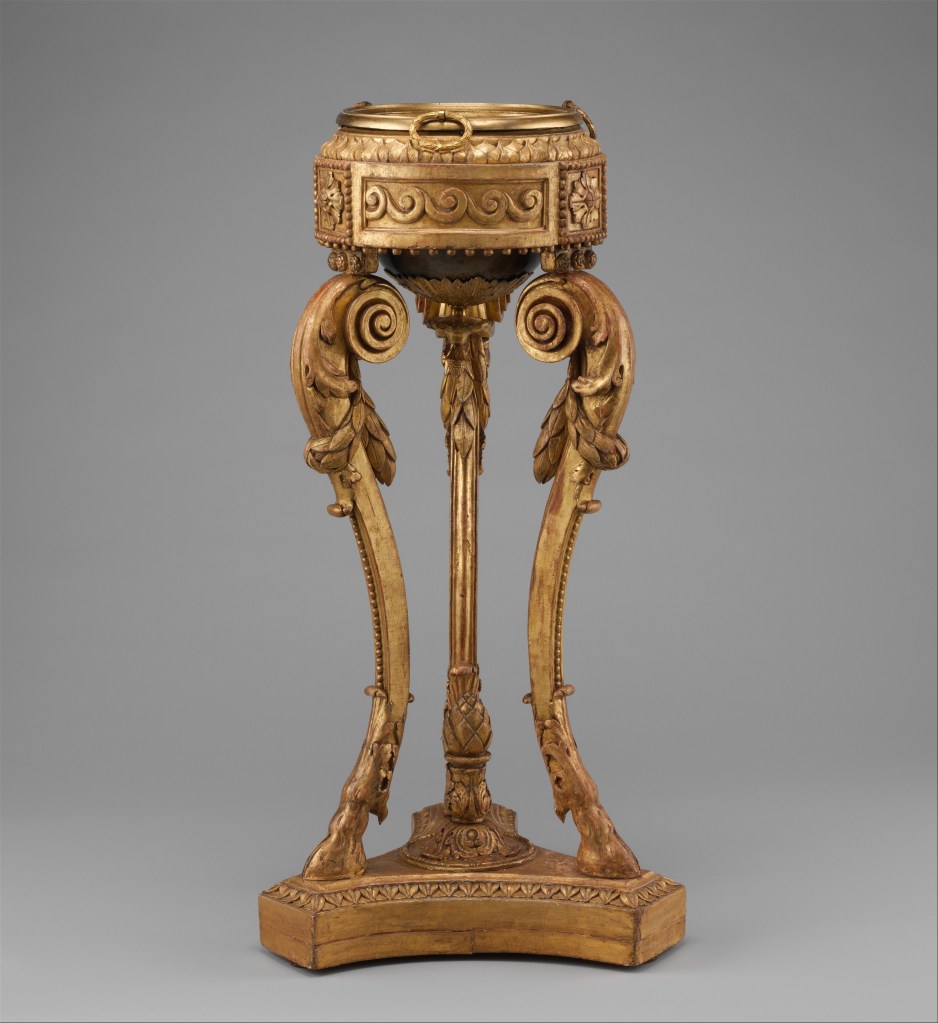
It has a tripod base resting on a moulded plinth with concave sides. This base consists of two winding consoles ending in a goat’s hoof and a central rear fork foot decorated with a network of scales resting on a spinning top foot. The base is decorated with an inverted cul-de-lampe with acanthus base and finial placed in the shape of a pine cone.

The architecture of this piece of furniture can be compared to a furniture model created by Jean-Marie Eberts. A Swiss banker established in Paris, he was also a collector and prints publisher. Around 1762-1733, he wanted to have a tripod made. We know that from an advertising engraving published in September 1763 in “L’Avant-Coureur” – now kept in the Warsaw Palace Library.

In his advertisement, Eberts declared that the Athénienne could be examined and acquired in gilder and colour dealer Jean-Félix Watin’s shop. This piece of furniture can also be used as a pedestal table, console, perfume or pot-pourri burner, as a stove for drinks, toilet bowl, fish tank or planter.
Jean-Marie Vien (1716—1809) was inspired by a painting displayed in 1763 at the Salon. This painting belongs to a series of 4 – as for the seasons – made for famous Madame Geoffrin. Winter shows a priestess burning incense on a tripod. Better known as The Virtuous Athenian, the subject would give its name to a revamped antique tripod. This piece of furniture can also be used as a pedestal table, console, perfume or pot-pourri burner, as a stove for drinks, toilet bowl, fish tank or planter.
Vien’s painting gained considerable success and was also widely distributed through Jean-Jacques Flippart’s engraving (1723—1782), published in 1765.
This type of furniture remained popular well beyond the Greek-style fashion since we can find similar consoles signed by the best cabinetmakers until the First Empire.

Several copies of this console have survived. One of the oldest may have been given to Madame du Barry in 1774 for her residence in Louveciennes. Another one features in a portrait of the Duke of Chartres, painted in 1775 by Charles Lepeintre (Palace of Versailles). The Nissim de Camondo museum also keeps a pair (inv. CAM 37.1). Another pair was bequeathed by Mrs. Charles Wrighstman to the MET in New York in 1993 – the most faithful transposition of Eberts’s print. All their details and similarities suggest that they could be the work of the same Parisian carpenter. Historian Francis Watson, who put forward this hypothesis, also puts forward the name of Adrien-Pierre Dupain, master in 1772, who may have specialized in this type of production.

Exhibition
« Beautiful as the antique, 1750-1815. Echoes and borrowings from the Indian Ocean», MADOI, 2018, reproduced in catalog: vol. I
Bibliography
- Emile Dacier. “En marge du “Monument du Costume” : l’Athénienne et son inventeur.” Bulletin de la société de l’histoire de l’art français, 1931, p.176-177
- Emile Dacier. “L’Athénienne et son inventeur”. Gazette des Beaux-Arts, 1932, tome VIII, p. 112-122
- Emile Dacier: “La mort et l’inventaire après décès de Jean-Henri Eberts.” Bulletin de la Société de l’Histoire de l’Art Français 1950, p. 167-176
- Svend Eriksen, F.J.B. Watson. “The “Athénienne” and the revival of the classical tripod”. The Burlington Magazine, mars 1963, vol 105, n°720, p. 108-112
- Daniëlle O. Kisluk-Grosheide, Wolfram Koeppe et William Rieder. Mobilier européen au Metropolitan Museum of Art : faits saillants de la collection. New York et New Haven, 2006, figure 97
- Anne Dion-Tenenbaum, “L’Athénienne” cat. expo., D’après l’antique, Paris, musée du Louvre, 2000-2001,
- Bertrand Rondot, Musée Nissim de Camondo, la demeure d’un collectionneur, les arts décoratifs, 2007, p. 308
- Svend Eriksen, Early Neo-classicism in France, Faber & Faber, 1974, pp. 138. 343, pl. 186
- Nadine Gasc et Gerard Mabille, Le musée Nissim de Camondo, RMN/UCAD, 1991, p. 49
- Claude-Paule Wiegandt, Le mobilier français Transition Louis XVI, éd. Massin, 1995, p. 41
This article was originally written in French by Thierry-Nicolas Tchakaloff. Translation by Laurent Garcia.
 Lavilépi En