

(Picture © Jacques Kuyten)
Mounted cabinet with two leaves
Lightly sculpted ebony
India, Coromandel coast, Nagapatnam (?), 1650-1680
Dimensions : H. 147 x L. : 123 x Prof: 62 cm
Description
This formal cabinet is made of two independent yet complementary parts: a box that fits into a cabinet holder with feet.
The cabinet holder consists of a crotch-frame, support-height table with two drawers with enclosure. The latter is embellished with a large frieze carved with arabesque motifs. This type of carved and pierced ornamentation is also common – if not characteristic – of furniture crafted on the Coromandel coast. Golden brass rosettes mark the centre of these windings.
The drawers with drop handles in chiselled and gilded brass can be locked. They feature motifs of Hindu mythological figures, half bird (Hamsa) half lion (Yali), inspired by the fantastic bestiary of South India which gained interest again under the Nayak dynasties in Tamil Nadu in the 17th century.

Left : Hamsa and Yali, bronze, India, Deccan, 17th century.
Right : composite mythological animal with a mythical lion head (Yali) and a bird body, bronze, South India, 17th-19th centuries.
Hamsa is a water bird – goose or swan. In the Rigveda, Hamsa is able to separate Soma – a ritual brew believed to give immortality to the Gods of the Hindu pantheon – from water when the two are mixed. Hamsa represents vital breath and is the vehicle of god Brahma. At the end of medieval times, its image was associated with that of a messenger and was used as a decorative, lucky element.
Yali is a composite animal. In the 17th century, under the Nayaks, the mythological bestiary got more varied. Its formal combinations are countless – it can take the shape of a bird for instance. It is frequently used in temples and households due to its protective role, as it is believed to ward off evil.
The connecting dice rest on turned vases.
This structure is solidly erected on a second support consisting of a frame which is underlined by a frieze of lambrequins, decorated with plant motifs and resting on ovoid feet. Chiselled and gilded brass reinforcements are positioned at the frame’s corners.
The upper part – the cabinet itself – is made of a sober box closed by two doors, or leaves, that open onto the cabinet’s interior. These leaves were originally locked. Their external faces are divided into rectangular and horizontal registers carved in light relief with upholstery patterns of interlacing in a geometric frame.

© Jacques Kuyten
The cabinet’s sides and top are also decorated with the same ornamental upholstery registers. On top is a frieze of gilded brass columns that was added later.
Only the back side has no decoration. Indeed, it was not meant to be seen, because this type of furniture was supposed to be placed against a wall.
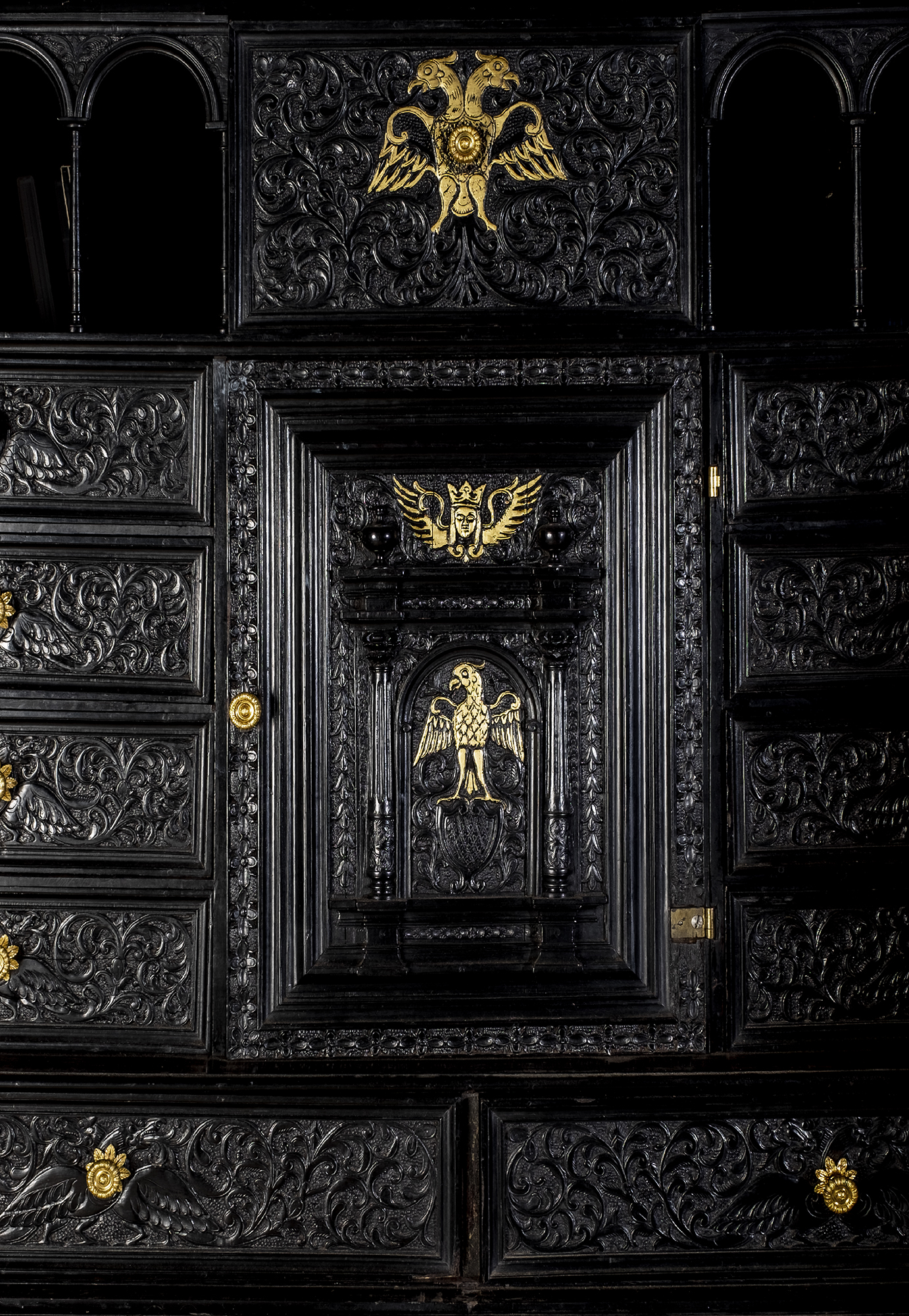
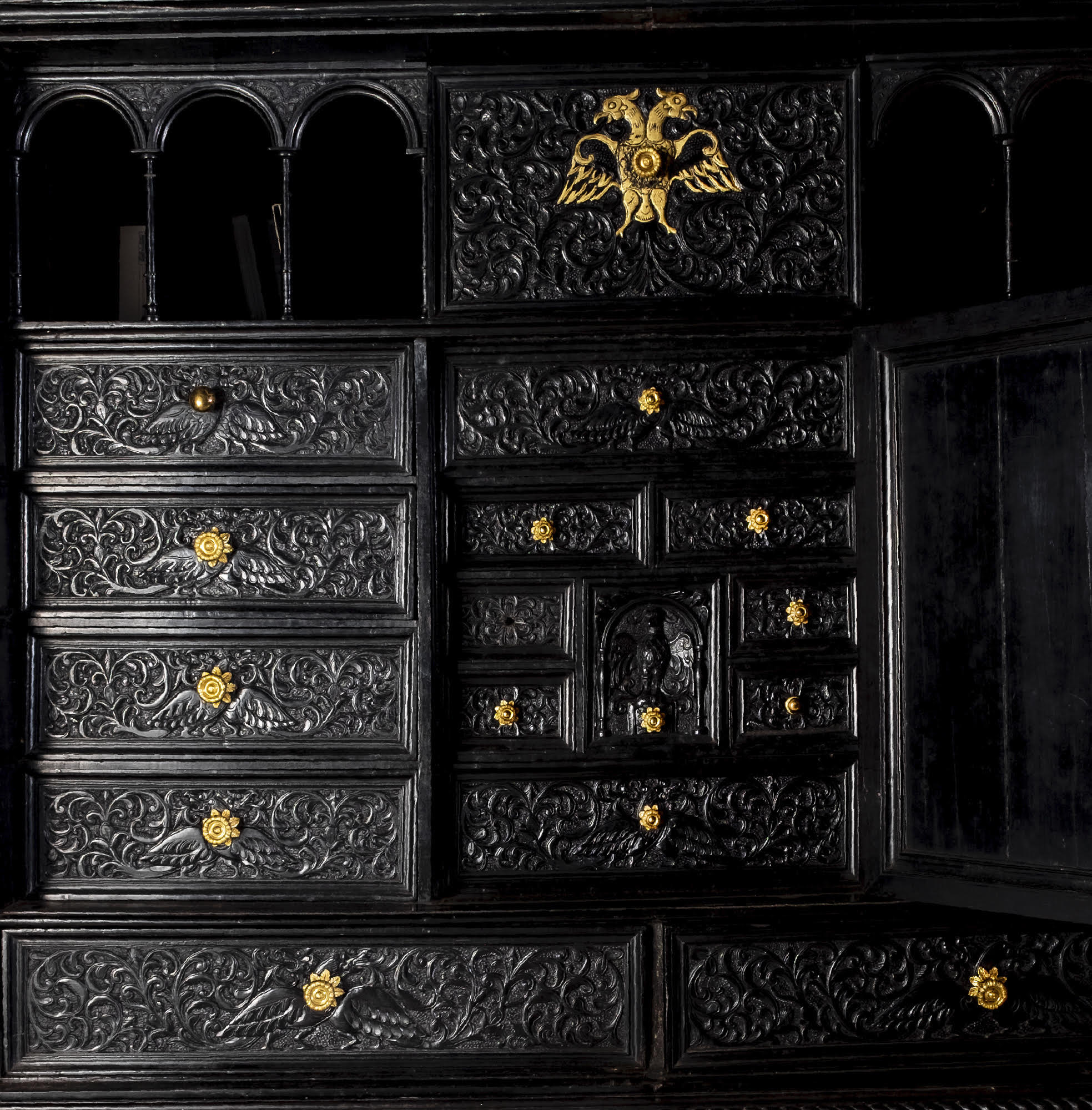
The open leaves (see picture above) reveal a composition centred on a door with architectural decoration. The ornamental repertoire is less austere thanks to animal and mythological figures already on the cabinet holder drawers’ facades. A multitude of compartments is revealed all around this door – no less than eleven different size drawers. The upper register is made of two suites of three arches supported by elegant small columns. Between these two sets is a large drawer adorned with a bird borrowed from Hindu mythology – the two-headed eagle known as Gandaberunda.
© Jacques Kuyten
Gandaberunda or Bherunda (« the mighty » in Sanskrit) is a two-headed eagle with supernatural, even magical, strength. It symbolizes the victorious fight against destructive forces.

Necklace (detail) with Gandaberunda, South India, Nayak workshop.
Gold, polished diamonds, emerald and ruby, Kundan type mount – specific gem-setting technique to avoid the use of claws.
Because of its symbolism, Gandaberunda is often considered the equal of a power and protection talisman against all visible and invisible harmful energies.
The central leaf’s decoration is different. Indeed, the door offers a “theatrical” setting sheltering an eagle with outstretched wings above an unidentified and potentially fancy coat of arms.
This door uses the mains features of classical architecture inspired by antique times: an arch-shaped niche inscribed in a bay supported by two ornate double columns, or candelabra. The vessels on top of the entablature confirm it was borrowed from another element (gate or window).
In the Netherlands, « classical » architecture gained more interest from the 1625s. Indeed, architects took care to implement classical rules precisely. By applying the mathematical rules according to which heaven and earth are supposed to have been created, Protestant architects sought to emulate the harmony of creation, in order to reach a beauty canon that was deemed perfect. This explains the interest in antique architecture which was then considered to be based on the same principles. These models were widely disseminated via translations of Vitruvius’s theoretical works, of the treatises of Serlio and most of all Vincenzo de Scamozzi’s in 1615 – the most popular.
A winged (?) and crowned mermaid features on the upper register. The fronts of these drawers show the same decorative motifs of intertwined animals – half bird, half lion – whose tail feathers end in exuberant arabesque scrolls.
When open, this leaf reveals the cabinet’s most secret part with a series of nine different size drawers decorated with the same patterns (see picture above).
© Jacques Kuyten
Why ebony
Ebony is the only material used for this cabinet, with the exception of the gilded brass lock elements, which were probably added later.
This is solid wood which reveals overseas origins. Indeed, with the development of the sea route to India and chartered companies in the 17th century – i.e. the various India companies – new varieties of wood arrived in Europe in the carpentry workshops. Mainly, ebony. Though it was already known thanks to the Portuguese and the Spanish, the Dutch imported it in large quantities from Mauritius, South India or Sri Lanka.
Perfect black “Indian ebony” is Diospyros ebenum‘s heartwood. It grows in the south of the Deccan Peninsula as well as in Sri Lanka. A very hard wood, difficult to work then, it was considered the most precious of exotic woods at the time. Rare and expensive, its very fine grain allows a perfect, smooth and shiny polish. That is why it was sparingly used in Europe and exclusively in veneer.
This piece of furniture reveals traces of tools usually used by metal craftsmen (copperware, goldsmith, etc.) – the only tools capable of cutting this very hard wood.
Typology
The architecture of this piece of furniture belongs to a small group of lightly carved ebony cabinets made between 1650 and 1680 both in India (Coromandel coast) and in Sri Lanka or Indonesia (Batavia).
All feature similar cubic proportions and an almost austere formal abstraction reflecting a phenomenon that prevailed in the Netherlands in the second half of the 17th century. Indeed, after the separation of the Protestant provinces from Catholic Flanders in 1609, the Republic of Holland became a world sea power and Amsterdam the richest city in Europe. All art forms benefited from the Netherlands’ growing prosperity. In Protestant Holland, baroque style was less flamboyant than in the Catholic provinces in which the Rubens and Italy’s influences prevailed.
Overall, the choice of materials and theatrical effects show more restraint than in Antwerp cabinets. Northern cabinetmakers moderately subscribed to Baroque ideas. They avoided the use of columns and pilasters, mouldings and overly decorative elements such as temple facades.
Such characteristics can obviously be seen in the colonies’ cabinets. However, they are enriched with an abundant and repetitive decoration, mainly plant motifs that cover all of their faces.

Special thanks to Guus Roëll Gallery (Maastricht)(item n° 13).
Right : Double-leaf cabinet on legs, Batavia, circa 1650, cabinet holder circa 1700
Special thanks to Indar Pasricha Gallery (London).
Another one can be seen at Gemeentemuseum-Kunstmuseum (The Hague).
Analysis of the decoration of a horizontal panel
This decoration seems to be drawn directly from the decorative repertoire of textile art, and in particular that of medallion carpets. The medallion motif was a common ornament at the time. Inspired by the Mughal repertoire under Persian influence, it became popular in Deccan and can be found in goldsmith’s work as well as in printed and dyed textiles, or in embroidered textiles (floor mats, drapes, blankets and table rugs).

Special thanks to Slava Tchakaloff
A polylobed medallion is at the centre of this carpet (in dark blue), surrounded by its borders (dark blue rectangles).
Standing out against the matt background, arabesque scrolls seem to spring from a blooming flower located right in the centre (light blue). They are deployed according to a double system of plant trellises intersecting on different planes (yellow and light blue). Intersections are marked by open flower corollas from which other branches emerge. The branches and leafy stems that intertwine in a rigorous geometric ordering remind the traditional concept of superimposed celestial networks.
In India, the 17th century saw the development and triumph of floral decorations in all different forms. Evocation of a spring garden, direct allusion to the heavenly garden referring to the notion of Paradise, it deploys the ancient motif of the tree of life, of the vase of abundance, of flowered trellises or of their multiple variations.
Paradise, carpet and garden are tightly linked. The central field becomes a metaphor for the celestial worlds and paradise, while the borders evoke the different enclosures surrounding it.

Borrowed from medallion carpets, the theme of the polylobed medallion is developed on all media. © Hôtel Drouot
The treatment of the main border with its frieze of rolled foliage (in pink) takes up, while extending them, the philosophy of the central field. It is possible that this acanthus leaf treatment is borrowed from Western motifs that can be found in the collections of models of needlework, then widely distributed in the colonies. This same repertoire also adorns the margins and borders of miniatures from the school of Tanjore, in Tamil Nadu.

(musée des arts décoratifs de l’océan indien, Saint-Louis, île La Réunion)
© Jacques Kuyten
The fast of Nayaks courts
The coexistence of these Islamic, Hindu and European repertoires is ostensibly linked to the culture prevailing in Tamil Nadu under the Nayaks dynasties which reigned from the 16th to the 18th century. The Nayaks were provincial governors, feudatories of the vast Vijayanagar Empire in South India. In the middle of the 16th century, with the fall of this empire, artistic and cultural life fell back on the local principalities and emigrated to the southern courts of Keladi, Tanjore, Maduraï and Gingee which declared their independence.
Craftsmen and artists fled to these neighbouring Hindu kingdoms, which partly explains the taste for luxury that will win them. These rajas never ceased to compete with Deccan sultanates. Nayaks courts were distinguished by their remarkable patronage of literature and the arts – architecture, music, poetry, mural painting, miniature, jewelry, textile arts, etc. – echoing the splendours of the fallen empire. Contrary to popular belief, Vijayanagar was not a Hindu state opposed to the Mughal Muslim world. The two cultures have always been mixed up.
This adopted, integrated and assimilated diversity can be found in the kingdoms of South India which have shown a remarkable spirit of openness, including towards Europeans. In Madurai, king Nayak Thirumalai had an Indo-Mughal style palace built with help of an Italian architect in 1636. In Tanjore, the reign of the third Nayak king, Raghunatha (1600-1634), was marked by a remarkable development of visual arts, music and literature. He also maintained special relationships with Europe, allowing the Danes to settle in Tranquebar (now Tharangambadi) in 1620. The splendour of Nayaks dynasties helped different decorative repertoires interweave.
Bibliography
- Monique Riccardi-Cubitt, Un art européen, le cabinet de la renaissance à l’époque moderne, les éditions de l’Amateur, 1993
- Richard Leslie Brohier, Furniture of the Dutch Period in Ceylon, National museum of Ceylon Publication, 1969
- Amin Jaffer, Furniture from British India and Ceylon. A catalogue of the collections in the Victoria and Albert Museum and the Peabody Essex Museum, Victoria and Albert Museum Publications, Londres, 2001
- Anna Jacson, Amin Jaffer, Encounters. The meeting of Asia and Europe 1500-1800, éd. Victoria & Albert Museum, 2004
- Geoffrey Eatscott Pearse, Eighteenth century Furniture in South Africa, Van Schaik, 1960
- Auguste Chevalier, « Sur l’orgine des Ébènes commerciaux de l’Antiquité, du XVIIe-XVIIIe siècle et de l’époque contemporaine » in Journal d’agriculture traditionnelle et de botanique appliquée, 1934/159, pp. 948-965
- Frederik de Haan, Oud Batavia : gedenkboek uitgegeven ter gelegenhei, éd G. Kolff et Co, 1922
- Jeanne Terwen de Los, Het Nederlands Koloniale Meubel. Studie over meubels on de voormalige nederlandse koloniën Indonesië en Sri Lanka, éd. T. Wever, 1985
- Dr V.I. van der Wall, Het Hollandsche koloniale barokmeubel, éd. de Schikel, 1939
- Jan Veenendaal, Furniture from Indonesia, Sri Lanka and India during the Dutch Period, Volkenkundig Museum Nusantara, Delft, 1985
- Jan Veenendall, Asia art and Dutch taste, éd. Wanders Uitgevers, La Haye, 2014
- Valérie Berinstain, Dominique Cardon, Thierry-Nicolas Tchakaloff, Indiennes et Palampores à l’île Bourbon au XVIIIe siècle, Maison Française du Meuble Créole, Saint-Louis, 1994
- Thierry-Nicolas Tchakaloff, Quand les Dieux s’asseoient à la table des hommes. Iconographie du panthéon Hindou, MADOI, 2004
- Thierry-Nicolas Tchakaloff, Visions de Paradis, la quête de l’Éden, éd. MADOI, 2011
- Marika Sandar, « Carpets from the Islamic Worlkd, 1600-1800 » in Heibrunn Timelife of Art History, The Metropolitan of Art, New-York, 2000
- Daniel Walker, Flowers Underfoot : Indian Carpets of the Mughal Era, The Metropolitan of Art, New-York, 1997
- Navina Najat Haidar, Marika Sandar, Sultans of the South : Arts of India’s Deccan Courts, 1323-1687, The Metropolitan Museum of Art, New-York, 2011
- Amelia Peck, Interwoven Globe: The Worldwide Textile Trade, 1500-1800, The Metropolitan Museum of Art, New York, 2013
- Vincent Lefevre, Commanditaires et artisans en Inde du Sud. Des Pallava aux Nayak (VIe –XVIIIe siècles), Presse Sorbonne Nouvelle, Paris, 2006
- V. Vriddhagirisan, The Nayaks of Tanjore, Asian Educational Service, Madras, 1995
This article was originally written in French by Thierry-Nicolas Tchakaloff. Translation by Laurent Garcia.
 Lavilépi En