

(Picture © Jacques Kuyten)
Gilded bronze ornaments
Guerhard and Dihl manufacture, known as the Duke of Angoulême’
Movement by Jean-Nicolas Schmit in Paris
Figures by Charles-Gabriel Sauvage aka Lémire
France, circa 1796—1800
Dimensions: h. 32 × w. 40 × d. 10 cm
This clock was manufactured at Dihl and Guérard’s porcelain factory. Christophe Dihl (1752—1830), a talented modeler / experienced chemist – he developed his own colours for porcelain – joined forces with the Guerhards, the company’s financiers – to create this manufacture in 1781. It quickly grew to become the Sèvres manufacture’s main competitor. When it was created, it obtained the protection of a royal family member, the young Duke of Angoulême, nephew of Louis XVI.
This clock reveals the Anglomania that spread at the court of France at the end of the Age of Enlightenment. A trend that would last into the early 19th century. It is made of biscuit porcelain delicately tinted in lavender blue, an imitation of the productions of famous Josiah Wedgwood’s Etruria factory, which the French aristocracy loved. This factory, created in 1768, was famous for its production of fine sandstone with a matte appearance, adorned with antique bas-reliefs, often in white, standing out against a paste coloured by oxides. The Duke of Angoulême’s manufacture specialized partly in these skilful imitations.
At the top of the clock, an antique ornamental vase. This oval-shaped covered vase, perhaps a potpourri, stands on a pedestal. It is decorated with antique foliage handles and decorated with garlands of laurel leaves on its belly. The lid is topped with a pomegranate-shaped grip. Its shape seems to be inspired by then fashionable pieces of goldsmith’s work, borrowed from the Etruscan style fashioned by Robert Adam.

The circular enamel dial, delicately outlined with gilded bronze ornamentation, is inserted into a case. It is signed “Schmit à Paris”, indicates hours in Arabic numerals and graduations per minute. The eight-day movement strikes hours and half-hours. Jean-Nicolas Schmit, who died in 1820, is considered one of the most important watchmakers of the late 18th and early 19th centuries. A master in 1781, he moved to rue Betizy in Paris and quickly achieved notable success due to the high technical quality of his movements. Dihl and Guérard hired him for the manufacture of the vast majority of the pendulums mechanisms they produced.
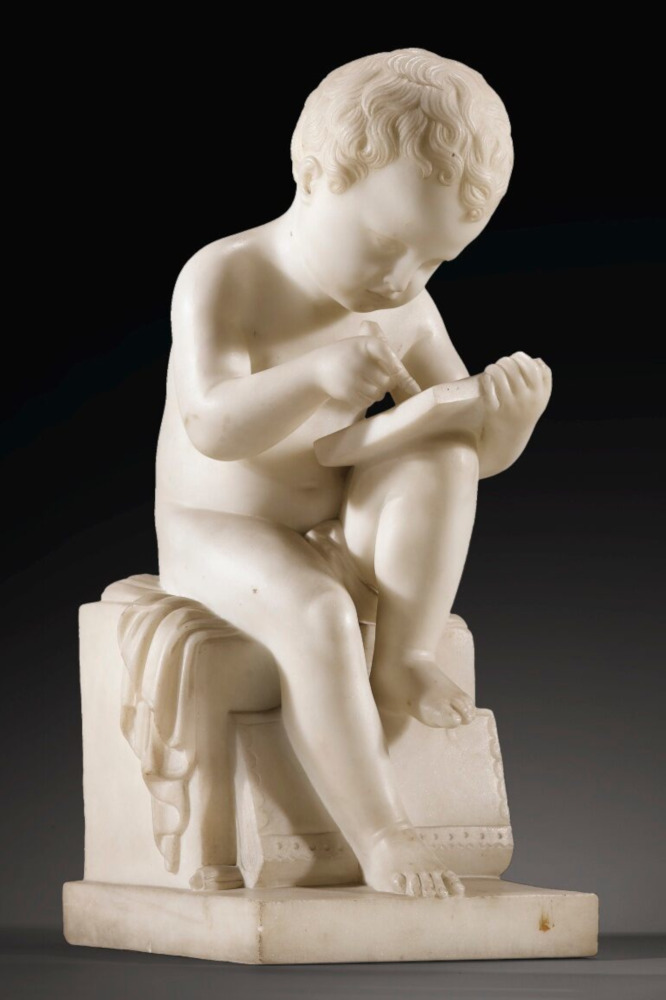
Two children seated, legs stretched out, wearing a headband, lean on either side of the case. One is writing on a tablet on his lap while the other seems immersed in reading a book. This double allegorical subject, very fashionable at the end of the 18th century, symbolizes two aspects of Knowledge.


These figures created around 1795 can be attributed to sculptor Charles Gabriel Sauvage (1741—1827), known as Lémire, who made variations on this theme. Lémire was art director and head of the modelling workshop at the Niderviller earthenware factory, known as Comte de Custine’s, in Lorraine, from 1781, before moving to Dihl’s service, like all the workers, after the execution of the Count of Custine in 1793 and the temporary closure of the factory which became national property. All the manufacture’s models can be found in the catalogue of the sale after Dihl’s death in 1830. Among them, the figures of Mr. Lemire ” the child drawing ” and ” child reading “. The Louvre Museum has a pair of bronze children reading and drawing by Lemire (inv. OA 11223 and OA 11224). The child reading is also represented in the portrait of Dihl made in the year VI (1797—1798) by Charles Étienne le Guay (1762—1846) on a porcelain plate – now in the Sèvres museum.
Childhood was already a highly used theme by artists of the Renaissance and then of the classical period. Unsurprisingly, it became popular again during the neoclassical period, where reference to Antiquity was constant. Many artists went to Rome to study – their first direct contact with the Antique. Usually they practiced studying and copying famous statues, but also restoring recently discovered works.
In Sèvres, this subject is a full separate theme. Children represented alone or in groups, chubby and chubby-cheeked, were treated as picturesque subjects, illustrating itinerant and seasonal trades, scenes of games, bacchanalia or animal training, allegories of Love or any other fashionable metaphor. Above all, these subjects were pleasant and their decorative role did not exclude, as here, a moral aspect conveying another meaning.
(© Sotheby’s)

(© Galerie Atena)

© RMN-Grand Palais (Sèvres, Cité de la céramique) / Jean-Claude Routhier
The base with projections rests on gilded bronze feet. Decorations are inscribed in reserves, hemmed with friezes of gilded bronze beads, with interlacing and arabesque motifs in light white relief standing out against the matt blue background – borrowed from what was developed by Josiah Wedgwood.
The balanced composition of this remarkable object takes up the architecture of the so-called “study” clock. The latter’s model was produced by merchant-mercer Daguerre and executed by bronzier François Rémond around 1785. The allegorical figures of Study and Philosophy – or arts and sciences – were originally created by Louis-Simon Boizot (1743-1809) for the Manufacture de Sèvres. This clock had considerable success in French at the end of the 18th century, even into the beginning of the following century. It loosely inspired Dihl who implemented a more ancient Greco-Roman style.

Exhibition
« Beautiful as the antique, 1750-1815. Echoes and borrowings from the Indian Ocean», MADOI, 2018, reproduced in the dedicated catalogue: vol. I p. 34
Bibliography
- Pierre Verlet, Les bronzes dorés du XVIIIe s., Paris 1987
- Pierre Kjellberg, Encyclopédie de la pendule française du moyen age au XXe s., éd. de l’Amateur, 1987 (p. 342)
- Régine Plinval de Guilllebon, La manufacture de porcelaine de Guerhard et Dihl dite du duc d’Angoulême, The French Porcelain Society, 1988, IV
- Hans Ottomeyer et Peter Pröschel, Vergoldete Bronezen, Die Bronzearbeiten des Spâtbarock und Klassismus, vol. I et II, éd. Klinhardt und Biermann, Munich, 1986
- Amaury Lefébure, musée du Louvre, Nouvelles acquisitions du département des Objets d’art, 1985-1989, Paris RMN, 1990-1991, pp. 229—231 n. 111 A et B
- Emmanuel Bénézit, Dictionnaire critique et documentaire des peintres, sculpteurs et graveurs, Gründ, 1999, T. 8, p. 494
- Claude Nordman, « Anglomanie et anglophobie en France au XVIIIe siècle » in Revue du Nord / année 1984/261-262 / pp. 787—803
This article was originally written in French by Thierry-Nicolas Tchakaloff. Translation by Laurent Garcia.
 Lavilépi En
2 thoughts on “Biscuit porcelain mantel clock”