

(Picture © Jacques Kuyten)
Box (arqueta), Japan cryptomeria, black laquered (urushi), gold and silver powder decoration (maqui-e), mother-of-pearl inlay (raden), shagreen, gilded and pierced copper
Japan, Nanban style, late Momoyama or early Edo
Dimensions : h. 34 x w. 60 x d. 35 cm
The word Nanban comes from namban-jinou “barbarians of the south”. This derogatory word originally referred to the people of South and Southeast Asia. The word took on a new meaning to designate Europeans coming to Japan from the South by boat, first from Portugal, then Spain, later from the Netherlands and England. This period of Christianization ended with the almost total exclusion of Europeans in 1650, when the archipelago was closed to foreigners under the Tokugawa shogunate. Trade was not completely suppressed though, as the Dutch East India Company, V.O.C., remained the only intermediary based on the islet of Deshima in Nagasaki Bay.
The Momoyama period (1573-1600) is when Japan contacted with the West, via the arrival of Portuguese sailors in 1573. Lacquer objects adapted to the European taste. Mother-of-pearl inlays appeared on lacquerware after the 1592 Korean campaign, which brought Korean craftsmen back to Japan. The Edo period (1600-1868) began with a spirit of distrust regarding what came from outside. This resulted in a stubborn refusal of any commercial or cultural contact with the West, and to a period of reunification which generated an incomparable flourishing of the arts.
A result of trade between first Portuguese then Dutch merchants, and Japanese craftsmen, the so-called nanban-style lacquer objects adapted to European requests. They imitated models of Western furniture – chests with rounded lids, drawer boxes – or borrowed from traditional Japanese shapes decorated in a new way – writing cases, various boxes, etc… Objects of great luxury, the boxes with a decor mixing shagreen, lacquer and mother-of-pearl nevertheless tended to disappear circa 1640-1650, in favour of decoration painted in gold on a black lacquer background.
The boxes’ size determines their position in the dedicated nomenclature. The larger ones, those with a length between 40 and 80 cm, are called arqueta. They are also equipped with side handles for easy transportation. Others, larger still, are similar to real chests – which can measure up to a meter in length – and were traditionally reserved to store clothing.
These boxes are equipped with chiselled and gilded copper protections at the corners. This particular softwood box is coated with black lacquer on all its interior and exterior faces. It presents a rich painted decoration standing out against a background of ash grey shagreen. This material, the leather of a cartilaginous fish – here probably skate skin – came from Siam (Thailand) at the time. On its front face, a lanceolate cartouche, hemmed with mother-of-pearl iridescent reflections, stands out against a background which is also sheathed in shagreen. On the front, the decoration, painted in gold, shows an aquatic landscape bordered by tufts of flowering grasses, dotted with a few mother-of-pearl leaves – imported from India – in which a pair of long-tailed crested birds evolves – probably versicoloured pheasants, symbol of cosmic harmony, that foreshadows the advent of the great organizer of the universe. The top of the lid is punctuated by four identical mons – family crests – spaced at each corner, unidentified, and a large tormented cartouche featuring a garden scene. This reserve is also fringed with mother-of-pearl and stands out against a shagreen background. Gnarled branches of a flowering shrub, springing up behind a cleverly woven railing, serve as a perch for a bird, while three others flutter around. The back, like the sides, is decorated with diamond-shaped reserves presenting a floral decoration painted in gold, as sparkling and precious.


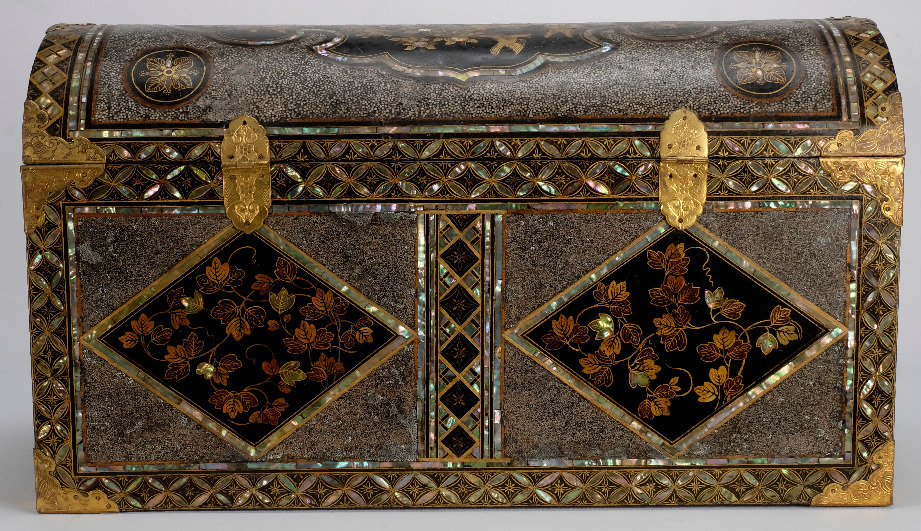

Right from the 17th century, Europeans considered Japanese lacquer superior to the Chinese one. Its quality justified a very high price. This type of very luxurious box was first produced for the Portuguese market – the major European purveyors of rare objects until 1640 – but could also be found in the Netherlands from 1610 – they are mentioned in the registers of the powerful Dutch East India Company (VOC). However, the first sales figures were disappointing and these objects did not find buyers because of their high price. The painted decor would evolve significantly to adapt to Dutch taste. Decors changed and were simplified. Naturalistic aspects prevailed over mythological figures, the composition got lighter, making the most of the subtlety of empty surfaces. These new registers can be linked to the decorative repertoire of so-called “transitional” porcelains, made in China in Jingdezhen, for the Dutch market.

A more modest box (w. : 24,5 cm) from the 1600s, kept at Ashmolean Museum in Oxford (n° EA 1985.53), has the characteristics of the oldest type, but without lacquer panel in the shagreen reserves.

The Guimet National Museum of Asian Arts in Paris keeps a Nanban style lacquered wooden chest decorated with mother-of-pearl and gold lacquer inlays (w.: 103 cm), made for export (late 16th / early 17th century). Its polylobed panels have vegetal and zoomorphic decoration.

Exhibition
Meeting foreigners? 16th-17th centuries, Museum of Decorative Arts of the Indian Ocean, La Villa, Saint-Denis; reproduced in the eponymous catalogue p.111, notice p. 176
Bibliography
- C. van Rappard-Boon, Japaneses influences on Dutch art. Imitation and Inspiration from 1650 to present, 1991, ill. p. 70
- G. Lacambre et al, L’or du Japon, laques anciens des collections publiques françaises, IAC éd., 2010
- Olivier Impey, Christiaan Jörg, Japanese export lacquer 1580-1850, 2005
- Olivier Impey, « Japanese Export Art of the Edo Period and Its Influence on European Art » in Modern Asian studies, vol. 18, n° 4, pp. 685-697
- François Caron, Le puissant royaume du Japon, 1636. ed. Chandeigne, 2018
- Christine Shimizu, « Nouvelles acquisitions, département Japon » in Arts asiatiques/année 1989/44/pp. 107-118
- Christine Shimizu, Urushi, les laques du Japon, Flammarion, 1988
This article was originally written in French by Thierry-Nicolas Tchakaloff. Translation by Laurent Garcia.
 Lavilépi En