

(Picture © Jacques Kuyten)
Chiselled, gilded and black patinated bronze
Credited to Pierre-Philippe Thomire
France, Paris, circa 1820
Dimensions: h. : 35 x w. : 24 x d. : 11 cm
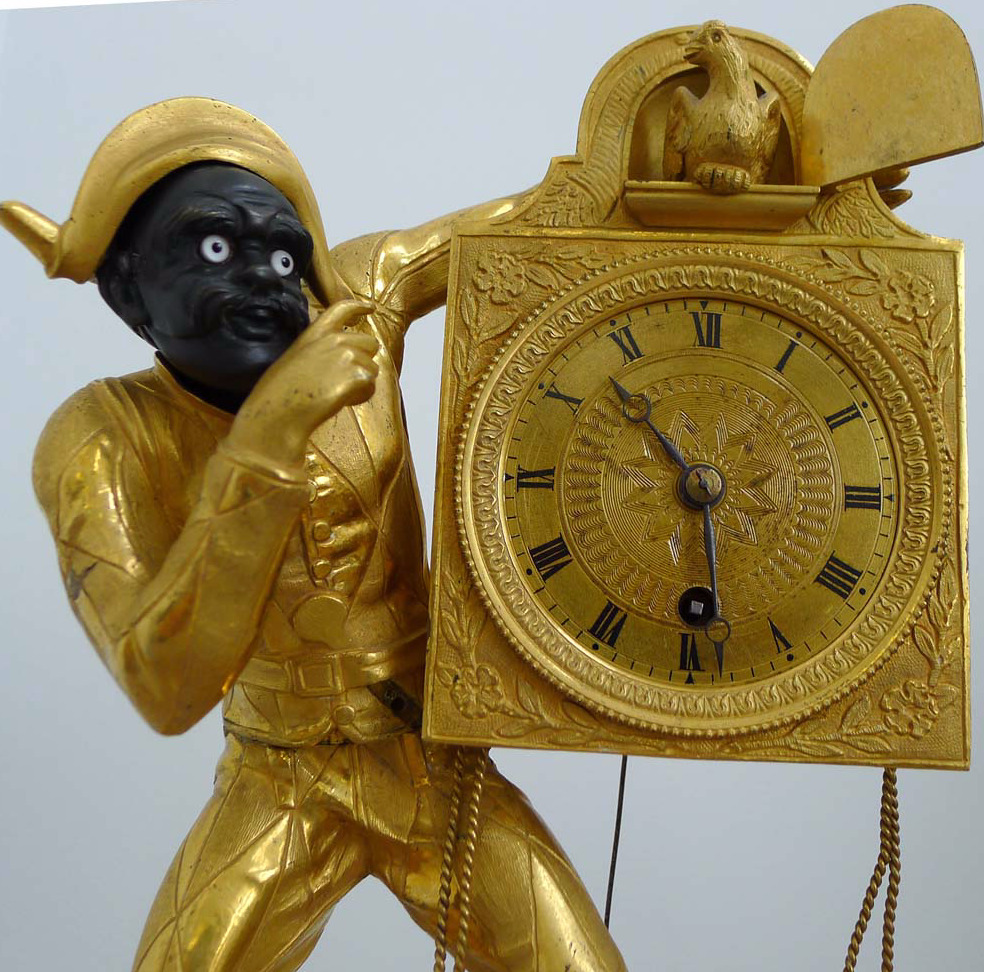
The golden circular dial with guilloché decoration indicates hours in Roman numerals and minutes with Breguet hands. Its eight-day movement is spring loaded. Hours and half hours strike with the same single tone. The mechanism is inscribed in a quadrangular case with an arched pediment adorned with cornucopias and a singing bird above. The case is decorated with flowering branches. Two false counterweights connected to gilt bronze ropes complete the set.
This composition evokes Germanic cuckoo clocks, quite up to date then. The oldest preserved model, made between 1780 and 1790, bears the signature of watchmaker Johannes Wildi (see picture below).

The case is supported by the agile figure of an Arlequin model. His weight lays on one leg. The slight swaying hips and the bust’s slight torsion give the pose a natural feel. He wraps his left hand around the case while wedging it against his hip. His finger pointing towards the dial seems to show the time. He is dressed in his typical outfit made up of multiple pieces of fabric that symbolize his multiple facets. Wearing a soft felt hat with a hare tail that does not completely cover his shaved head, his face is concealed by a half mask of black leather with a turned-up nose, decked out with a thick moustache and bushy eyebrows. His sulphide eyes sparkle. With his bat on his belt, he wears flat shoes that allow him to perform his acrobatic moves. These accessories are characteristic of this emblematic character of commedia dell arte. This composition rests on a rectangular base decorated with intertwined palms bearing fruits – symbol of vitality – bound by a ribbon.
Commedia dell arte is a form of popular Italian theatre that cast its shadow all over Europe. However, France was its second homeland. Indeed, Italian comedians received multiple encouragement and protection in Paris, despite the religious authorities’ hostile view. In the middle of the 17th century, they took up residence at the Palais-Royal, where they played alternately with Molière’s troupe. As early as 1698, actors began to perform in French. Driven out of the country for having offended Madame de Maintenon, reintroduced under the Regency, they merged with the Opéra-comique (fairground theatre) in 1762, before being dismissed again in 1780. Their influence was tremendous though. Molière, Marivaux and Beaumarchais found an inspiration and a source of renewal for their scenic play with Bergamasques, pantalonnades and other burlesque farces.

After the Revolution, theatres benefited from a new dynamic. Comedy of manners prevailed during the Empire and the Restoration. Comedy and vaudeville were then sought by an increasingly larger audience. Characters from the Italian repertoire, including Harlequin, did indeed spread their fantasy in French theatre, but also poetry and painting, or decorative arts. In France, Harlequin lost its rowdy, greedy and vulgar aspects to embody a more spiritual character, full of malice, ingenuity and slender elegance. It almost spontaneously became central in the renewal of comedy which took place from the beginning of the 18th century and which continued in the 19th century with the addition of carnival characters. The figure of the 16th-century buffoon, cheesy and superstitious at first, kept its traditional clothes – mainly its multi-coloured dress – only adorned with triangular patterns assembled instead of patched pieces. He kept his cap and his black mask from its origins of charcoal burner from the lower town of Bergamo, Lombardy. A few examples of this rare model are listed with some variants. One is kept at Palazzo Riccardi in Florence, another at the Quirinal Palace in Rome, and one is on display at the Duesberg Museum in Mons, Belgium. The latter bears the signature of watchmaker Louis Moinet, associated with that of bronzier Thomire.

Bibliography
- Tardy (Lengellé Maurice dit), French Clocks – The World Over, Tardy, Paris, 1981, vol. I, pl. LXXXIII,
- Niehüser Elke. Die französische Bronzeuhr, Eine Typologie der figürlichen Darstellungen, Munich, 1997, p. 168, fig. 270
- Gonzales-Palacios Alvar & Roberto Valeriani, I Mobilio italiani : il Patrimonio artictico del Quirinale, Rome, 1996, p. 309, n° 90
- François Duesberg, Musée françois Duesberg. Arts décoratifs, 1775-1825, Bruxelles, 2004
- Niclausse Juliette, Thomire fondeur-ciseleur 1751-1843 – sa vie, son œuvre, Gründ, Paris, 1947
- Frandon Ida-Marie. Commedia dell’Arte et imagination poétique. In: Cahiers de l’Association internationale des études francaises, 1963, n° 15. pp. 261-276.
- Lattarico, Jean-François. « Les monstres du langage. Le laboratoire plurilingue de la commedia dell’arte à la comédie ridiculosa (XVIe-XVIIe siècles) », Littératures classiques, vol. 87, no. 2, 2015, pp. 33-47.
- Lebègue Raymond. Premières infiltrations de la Commedia dell’Arte dans le théâtre français. In: Cahiers de l’Association internationale des études francaises, 1963, n° 15. pp. 165-176.
- Alain Viala, « les contradictions du théâtre dans les débuts de la seconde modernité » in Histoire du théâtre, P.U.F. 2012, pp. 78-91
- Ranzini Paola, « Entre zanni et valet du siècle des Lumières : Arlequin serviteur de deux maîtres » in: Littératures 39, automne 1998. pp. 153-175.
This article was originally written in French by Thierry-Nicolas Tchakaloff. Translation by Laurent Garcia.
 Lavilépi En
One thought on “Harlequin model mantel clock”