

Picture © Jacques Kuyten
Etruscan-style armchair
Stinkwood, yellow wood, ebony
Caned seat
South Africa, Cape Town, circa 1790
Dimensions: H.: 91 x W.: 62 x D.: 52 cm
(Jan Veenendaal’s former collection)
This stripped-down chair is characteristic of the so-called Etruscan style which was very popular at the end of the 18th century in Cape Town, South Africa.
On a wide and solid fully pegged frame, a thin H-shaped spacer ensures rigidity. The slightly inclined backrest has projections at the angles and in the centre of the concave upper cross member, and an openwork decoration composed of a fluted and hollowed out pilaster resting on the moulded projection of the lower cross member. Above the pilaster, an elegant, also openwork ring. The front legs are straight and tapered, inlaid with precious woods subtly mixing colours. The rear legs are slanted and the trapezoidal seat is darkened with a broad-stranded cane. The seat rail is smooth while the side ones are lined with simple grooves.
The front legs frames support the armrests which themselves support the slightly projecting arms that match the frame of the backrest at the end of a soft curve.
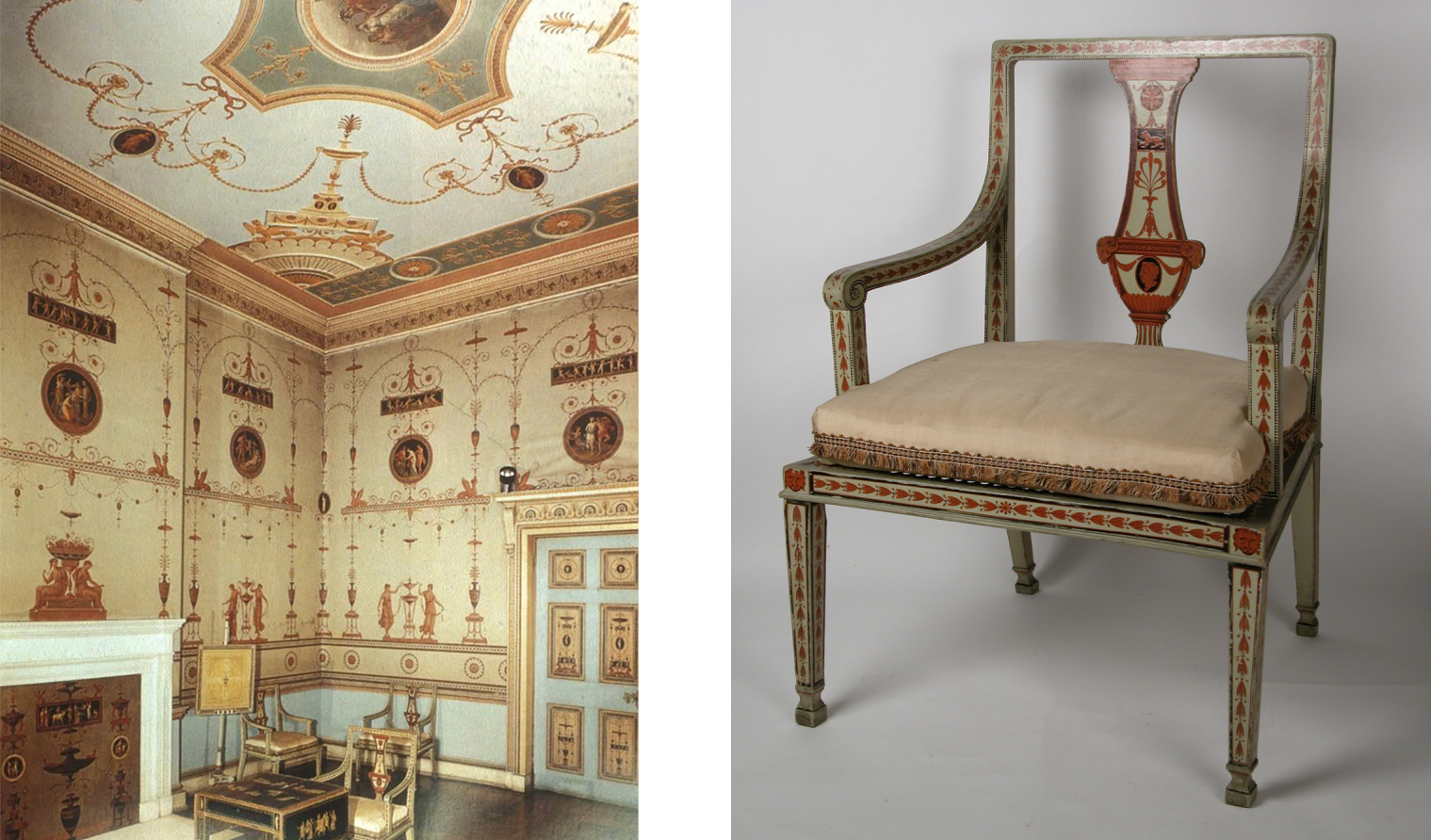
« Etruscan living room», Osterley House, London (general view on the left, detail of an armchair on the right).
Robert Adam (1728-1792) and his brother James (1732-1794) mostly worked for the English aristocracy. Knowledge of antique monuments and particularly of stucco or marble low reliefs led them to a new conception of interior decoration. Before them, taste for the Antique would show via transposition indoor of outdoor architecture. Robert Adam switched this pompous solemnity for a decoration of light stucco, foliage and grotesques on a light-coloured background. The design of the ceilings, carpets and furniture matched this wall decoration. The profound originality of the Adam brothers’ creations lies in these homogeneous sets.
The Etruscan style was theorized by brothers Robert and James Adam in England, but Georges Hepplewhite (1727-1794) ensured its dissemination. He simplified and changed the famous decorator’s lines to reach a wider audience. The Cabinet-Maker and Upholsterer’s Guide was published in 1788, two years after his death. It translates in both simple and elegant terms the more extravagantly styled neoclassical furniture designed by decorator Robert Adam (1728-1792), who worked exclusively for the aristocrat. The three hundred furniture drawings were praised for their simplicity, utility and elegance. The Guide immediately found a resounding success that crossed borders and secured the cabinetmaker’s reputation. As far as the armchair is concerned, we can find similarities with the drawing of a chair published in the Guide (see illustration below).
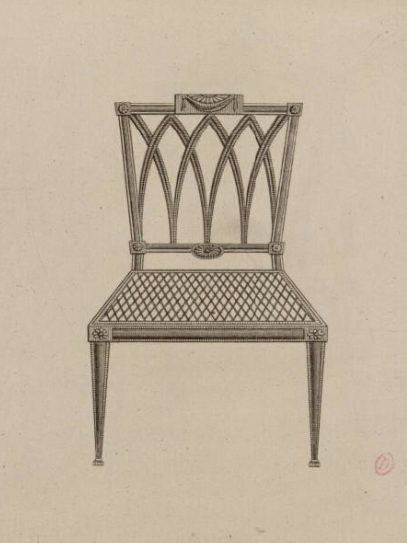
The back of the seat is embellished with carved heads inscribed in a square at each angle and a projection in the middle of the upper cross member decorated with an antique style urn. According to the author, the ornaments can be carved or painted (“Japanese style”). The seat is caned and the front legs are decorated with a central moulding in relief.
Woods
This piece of furniture is made from indigenous South African woods. The carcass is of stinkwood (Ocotea bullata), the most valuable local wood. It could be found on Table Mountain and in the country’s high forests. It provides very fine grain, tight, dense and smooth, dark walnut or reddish brown to black wood. It is highly sought for for furniture manufacturing. It is also called “Cape Town walnut tree” or “Cape Town Laurel”. The name “stinkwood” comes from a strong scent that reeks when it is freshly cut.
The front legs are inlaid with Yellowwood. All yellow-coloured woods were called lemon trees at the time but here it is a local variety of lemon trees (Psychotria capensis) which grows along the southern and eastern coasts of South Africa. Its hard, fine-grained wood is yellow brown to yellow.
It is likely that this armchair was originally part of a larger set comprising a pair of armchairs and a series of matching chairs to furnish a dining room according to the use of the time. Specific dedication of rooms in the homes of elites is well documented in Cape Town. The word « dining room » appears in the archives.
Little is known about the life of Georges Hepplewhite. His date of birth is uncertain. He is believed to have served his apprenticeship with Robert Gillow (1703-1773), a furniture maker in Lancaster. However, he was registered as a resident in London in 1768, where he opened his own shop on Redcross Street. After his death in London in 1786, his estate was administered by his widow, Alice, who continued to run the business. Our knowledge of the Hepplewhite style is primarily based on The Cabinet-Maker and Upholsterer’s Guide. The plates are not signed, but ten drawings signed “Hepplewhite” or “Heppelwhite” appear in The Cabinet-Maker’s London Book of Prices published the same year.
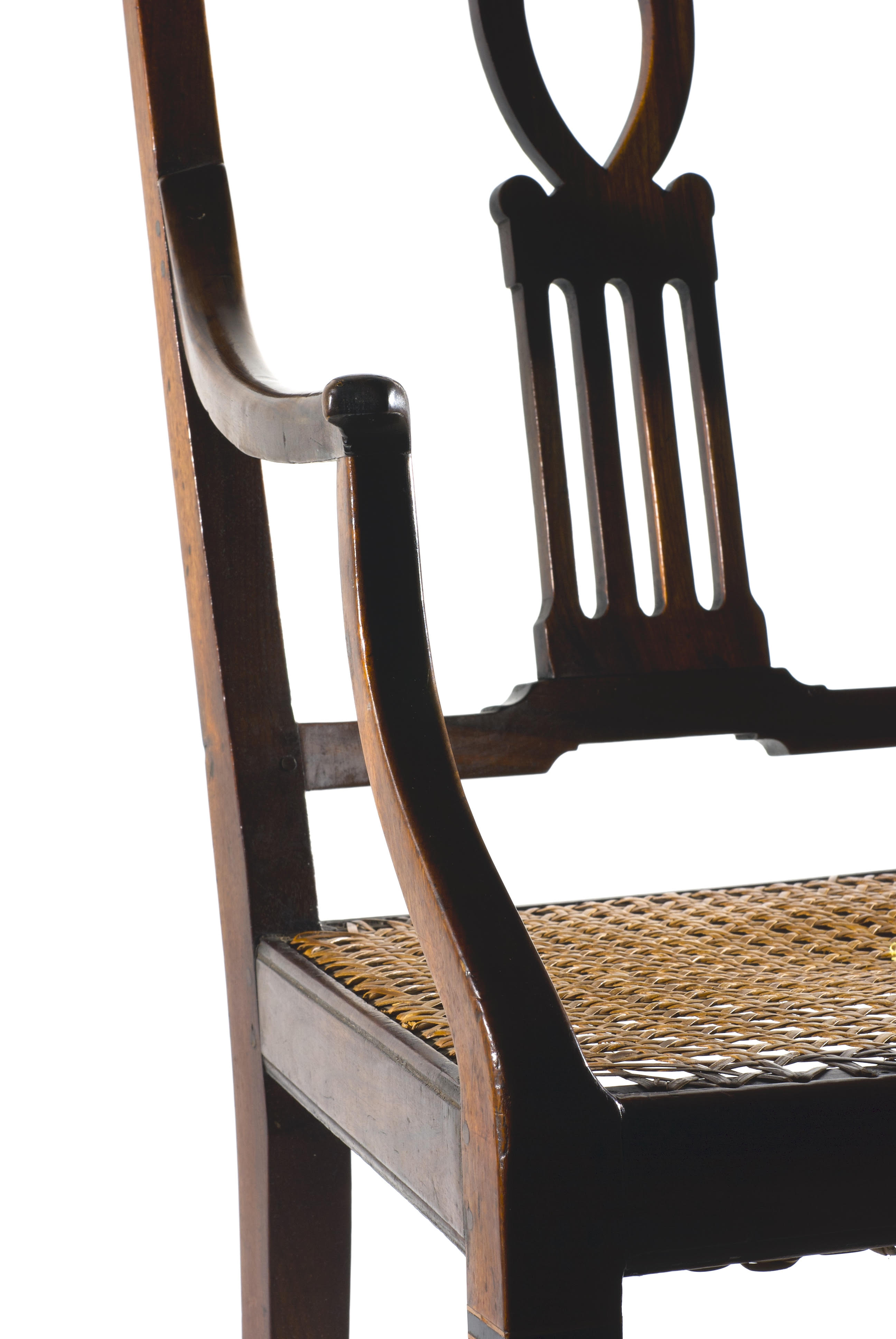
Detail of Etruscan-style armchair
Bibliography
- Sophie Thibier, « Le mobilier néoclassique en Afrique du Sud, source et interprétation » in actes du colloque, Le néo-classicisme comme élément fédérateur dans les colonies européennes aux XVIIe et XIXe siècles (s/dir. Thierry-Nicolas Tchakaloff), Musée des arts décoratifs de l’océan Indien, Saint-Louis, 2013
- Anton Obholzer, Michael Baraitser, W.D. Malherbe, The Cape House and its interiors. An Inquiry into the Sources of Cape Architecture & a Survey of Built in Early Cape Domestic Woodwork. éd. Stellenbosh museum, 1985
- Geoffrey Eastcott Pearse, Eighteenth century Furniture in South Africa, Van Schaik, 1960
- Michael Baraitser, Anton Obholzer, Cape Country Furniture. A Pictorial Survey of Regional Styles, Materials and Techniques in the Cape Province of South Africa, éd. A.A. Balkema, Cape Town, 1971
- Ronald Lewcock, Early nineteeth century Architecture in South Africa, éd. A. A.Balkema, Cape Town, 1963
- Lewis Hinckley, Heppelwhite, Sheraton & Regency Furniture, Washington Mews Book, New York, 1987
- Clifford Musgrave, Adam and Heppelwhite and Other Neoclassical Furniture, Faber, Londres, 1966
- Georges Hepplewhite, The Cabinet-Maker and Upholsterer’s Guide, éd. 1789, INHA, Paris (version numérisée 2012)
- Titus Eiliens, Domestic Interiors at the Cap and in Batavia, 1602-1795, éd Zwolle, La Haye, 2002
This article was originally written in French by Thierry-Nicolas Tchakaloff. Translation by Laurent Garcia.
 Lavilépi En