

Picture © Jacques Kuyten
Musician chair
Carved and pierced Indian rosewood, rotating seat
West India, Bombay Presidency, circa 1880
Dimensions: H.: 93 x W.: 41 x D.: 56 cm
The seat rests on four strongly arched legs with stylized wild animal claws endings – lion or tiger. These feet are linked by a wide openwork belt. The revolving seat’s height can be adjusted. The medallion-shaped backrest features stylized vine leaves and hanging clusters – also the repetitive motif of the openwork sculptures. The central medallion, formed by two foliated winding arches, is organized in a rigorously symmetrical manner. It seems to be supported by scrolls of acanthus leaves, and it is topped with a vine leaf from which leafy foliage fall down both sides of the backrest.

This decoration with vines is one of the many variations of the repertoires with foliated and flowery arabesque motifs, whose botanical motifs can be naturalistic, borrowed directly from the plant kingdom (oak leaves, daisies, etc.) or strongly stylized, with a symbolic meaning.
This particular typology comes from a model probably derived from one of the most prestigious monuments in Ahmedabad, the Siddi Siyyed Mosque. Built in 1573, it is famous for its jalis, whose extraordinary delicacies, admired by all, have been studied, copied and interpreted right from the beginning of the European presence in India. A jali is a carved stone screen, generally used in India in Islamic architecture. Its marble or stoneware screen filters light while allowing air to pass through. It also gives the ability to see without being seen.
From the middle of the 19th century, this unifying theme took over the art of furniture. It could be found on the furniture of the Bombay Presidency for instance. It honourably replaced printed textiles with complicated and tangled patterns. At the time, the living room i.e. the most important room in the house, had to be abundantly decorated for the benefit and image of the landlord. An empty room was the poorest choice one could make so every inch had to be filled with objects reflecting his or her interests and aspirations.

Low chair used for prayer, carved and pierced rosewood, India, Bombay Presidency, circa 1860-1870.
The central motif of the high backrest features a “tree of life” motif; it is surrounded by leafy serpentiform woody stems forming a polylobed arch.

Jali of Sidi Saiyyed Ahmedabad Mosque, Gujarat. The building is adorned with 10 jalis on the sides and at the rear, two openings of which are decorated with intertwining patterns of trees and leaves.
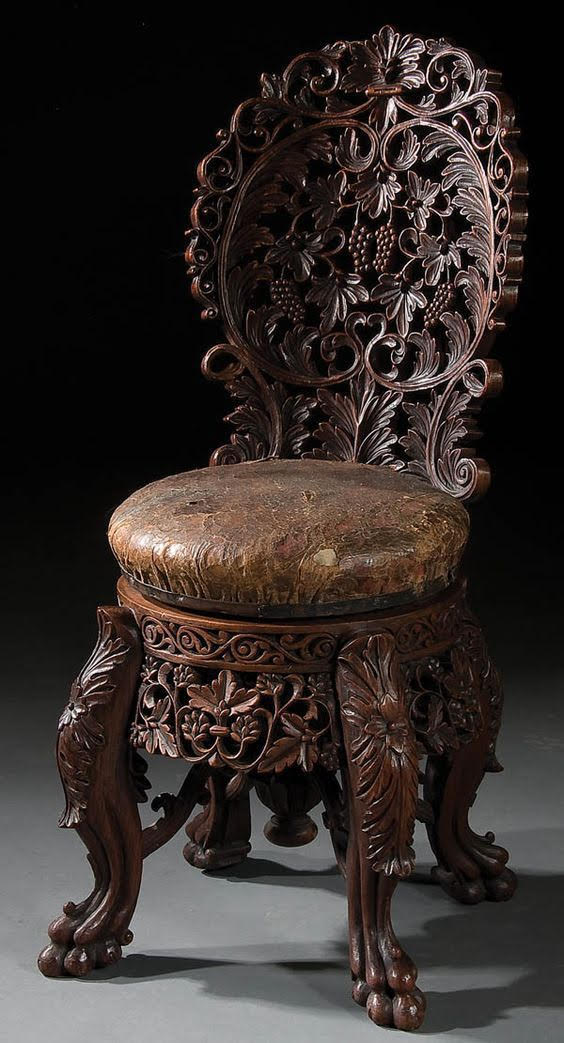
Musician’s seat with its original leather upholstery.
Bibliography
- Thierry-Nicolas Tchakaloff, Splendeurs mogholes. Architecture et arts décoratifs sous le règne des Grands Moghols du XVIe au XVIIIe siècles, Association Musulmane de la Réunion et Musée des arts décoratifs de l’océan Indien, Saint-Louis, 2002
- Thierry-Nicolas Tchakaloff, Arabesques et entrelacs. Influences persanes et européennes dans l’art textile en Inde, Musée des arts décoratifs de l’océan Indien, Saint-Louis, 2009
- Amin Jaffer, Furniture from British India and Ceylon. A Catalogue of the Collections in the Victoria and Albert Museum and the Peabody Essex Museum, V&A, Londres, 2001
- Helder Carita, Les palais de Goa. Modèles et typologies de l’architecture civile indo-portugaise, éd. Chandeigne, 1996
- Mordaunt Crook, The Rise of the Nouveaux Riches : Style and Status in Victorian and Edwardian Architecture, Jihn Murray, Londres, 1999
- Raymond Head, Indian Crafts and Western Design from the Seventeenth Century to the Present, RSA Journal, vol. 136, n° 5378, Janvier 1988, pp.116-131
This article was originally written in French by Thierry-Nicolas Tchakaloff. Translation by Laurent Garcia.
 Lavilépi En

One thought on “Musician chair”