

(Picture © Jacques Kuyten)
Chiselled and gilded bronze with matt and shiny patina
Movement by Lepaute in Paris
Credited to Claude Galle
France, Paris, circa 1810-1815
Dimensions: h. 50 × w. 37,5 × d. 15 cm
Height of the statue: 35 cm
The circular white enamelled dial, signed “Lepaute à Paris”, indicates hours in Roman numerals and minutes via two pierced and gilded copper hands. It is inscribed in a tree trunk on which Hercules is leaning.
Lepaute’s signature is that of a famous Parisian watchmaking dynasty from the end of the 18th century and the first decades of the 19th century. Here, it is probably and more specifically that of Pierre-Basile Lepaute (1750—1843), known as Sully-Lepaute, who joined his uncles, Jean-André and Jean-Baptiste, both watchmakers to the King, in Paris around the 1760s He bought the family business in 1789 and would supply clocks for the imperial and then royal unit.
The episode chosen to portray Hercules is singular since it does not directly illustrate an adventure. Wearing the Nemean lion’s skin, that he killed during his first job, he rests, leaning on his club with his right hand. The club, a symbol of virtue, is a gift from Vulcan. He holds the golden apples of the daughters of the night, the Hesperides, his eleventh work, in his left palm. The apples were kept in a garden at the edge of the world. The cut-off base rests on four clawed feet. It is decorated with Herculean attributes (remains of the Nemean lion, bow, arrows, quiver, …). Two snakes entwined around a fletched arrow allude to the young hero who strangled the monsters in his cradle.

The model is inspired by Hercules Farnese, a prototype of Hercules resting, discovered in Caracalla’s terms in 1546. It is a colossal marble statue, a Roman copy of the 3rd century AD.., which reproduces and enlarges a Greek bronze original from the end of the 4th century BC by sculptor Lysippus. A major piece of the Farnese collection, this sculpture is considered an absolute masterpiece, and has generated numerous copies and studies in Rome.

Exhibited at Palazzo Farnese until 1787, it was transferred to the Bourbons of Naples with the collection of antiques. Indeed, the Farnese dynasty died out in 1731 with the death of Antoine Farnese. All their goods were then bestowed to his little nephew, Carlos, who founded the kingdom of Naples in 1735. The victorious Directory even tried to recover the antique in Naples – the statue was on the list drawn up by Vivan Denon. A plaster cast was made in the 17th century by Charles Errard, director of the Académie de France, and then sent to Paris. We can find it in gilded bronze at the Château de Vaux le Vicomte – one of the largest statues of the time, six meters high – then in the gardens of Versailles where it stood, at the time, in a grove below the Mirrors Basin.

One can legitimately wonder about the dissimilarities between the figure of Hercules represented on the clock and that of the figure of Hercules Farnese. The ancient work has certainly been unanimously praised since its rediscovery; however, voices were already rising at the end of the 17th century, and even more so in the Age of Enlightenment, about the place it should be given in learning to draw. The idea of linking anatomy and antiquity is essential. The Laocoon, the Gladiator, the Fauna or the child Bacchus were consensual models, but Hercules’s exaggerated musculature, giving the feeling his head is too small, or his reduced private parts, were often criticized and the work was deemed “mannered”.
Nevertheless, the extraordinary and larger-than-life status of this character remains. Its popularity has not been altered in any way with both aristocratic and bourgeois audiences, and artists continued to treat this subject according to canons redefined or borrowed from other antique models. It therefore seems that this figure is part of this movement of reinterpretation of the subject. On the one hand, the hero’s musculature is lightened and softened, and he is dressed in a lion skin that partly hides his abdomen and private parts.
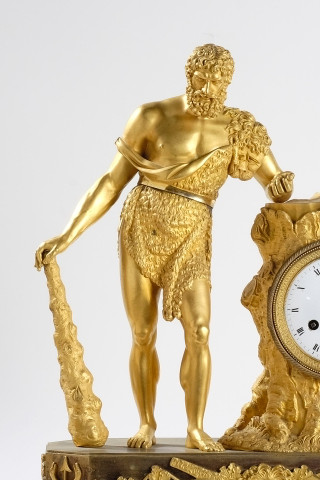

This model of pendulum has been very successful with several variations, especially in the patinas, alternating gold and green bronze. Under the Empire, several of these clocks bore the signature of bronzier Claude Galle (1759—1815); others, during the Restoration, displayed that of Feuchères and Fossey.
Claude Galle (1759—1815), master in 1786, appears to be one of the most important Parisian bronziers of the late 18th century and the Empire period. He first collaborated with art caster Antoine-André Ravrio and with Jean Hauré. Under the Empire, he was considered to be Pierre-Philippe Thomire’s main competitor. He produced a number of pieces for the decoration of the palaces of Compiègne and Fontainebleau, in France, but also for the palace of the Quirinale in Rome.
His son Gérard-Jean Galle (1788—1846) kept on when his father retired in 1813. Despite the recognition of his talent, he did not manage to cope and went into near bankruptcy. He made a desperate call for help to the restored monarchy which refused to buy his collection. It was probably when he ceded all or part of it to the Feuchères and Fossey workshops.
Lucien-François Feuchères (? —1841) was a bronze maker. Grandson of a gilder, and son of bronzier Pierre-François, to whom he succeeded, chaser-gilder Lucien-François ran one of the most famous companies of the first half of the 19th century. His works equal those of his father. His workshop in rue Notre Dame de Nazareth provided the imperial unit. His son Armand took on in 1823, along with his son-in-law André-Julien Fossey, continuing the family tradition. They have been distinguished several times for the quality of their work (Fine Arts category, bronzes section) by the National Industry Encouragement Society.

Bibliography
- Abraham Bosse, Représentation de diverses figures humaines avec leurs mesures prises sur des antiques qui sont de présent à Rome. Recueillies et mise en lumière par A. Bosse, graveur en taile douce Paris, 1656
- Hans Ottomeyer/Peter Pröschel. Vergoldete Bronzen, vol. 1., München, 1986, voir fig. 5.18.20
- Colette Jourdain-Annequin. « Héraklès en Occident. Mythe et histoire » in Dialogues d’histoire ancienne, vol. 8, 1982, pp. 227-282
- Elke Niehüser, Die Französiche Bronzeuhr, München, 1987, p. 64 fig. 89
- Morwena Joly, « Le modèle antique examiné sous l’angle anatomique : entre beau idéal et beau réel (1672-1812) » in Dix-huitième siècle, 2009/1 (n° 41), pp. 393-408
- Jean-Louis Ferrary, « La culture antique et l’europe ». Actes du 12ème colloque de la Villa Kérylos à Beaulieu-sur-Mer, 19 & 20 octobre 2001. Paris, Académie des inscriptions et Belles-Lettres, 2002, pp. 87-97
- Nadine Pontal, Le XVIIIe siècle et l’Antiquité, permanence et représentation, à travers les textes et l’iconographie, en Europe et principalement en France, DESS Réseaux d’information et document électronique, ENSSIB, Villeurbanne, 2001-2002
- Fernand Boyer, « L’héritage des Farnèse et Napoléon 1er (1806-1807) » in Bulletin de la Société nationale des Antiquaires de France, 1963. 1965, pp.173-174
- Félix Ravaisson, « L’Hercule ἐπιτραπέζιος de Lysippe » in Mémoires de l’Institut national de France, tome 32, 2ème partie, 1891, pp.13-56
This article was originally written in French by Thierry-Nicolas Tchakaloff. Translation by Laurent Garcia.
 Lavilépi En
One thought on “Hercules mantel clock”