

© Jacques Kuyten
Pair of folding outdoor armchairs known as “flâneuse”
Carved Indian rosewood
Caned seat and backrest
India, Indo-Portuguese work, Goa, circa 1860-1880
Dimensions unfolded chair : h. : 102 x w. : 69 x d. : 92 cm
These identical folding chairs can be considered very symbolic of the art of living in Goa, the former Portuguese colony located on the west coast of India, 400 kilometres south of Bombay (Mumbai). Each of them rests on six moving feet – forming three pairs – with tawny-clawed endings encircling a ball. These feet are decorated with leafy scrolls. The strongly rolled armrests and their consoles are also moving. The termination of these wide armrests serves as an anchor: when one gets up from the resting position, it makes it possible to stand up easily. The seat and back are caned. The backrest is crowned with a shell on top of a lyre-shaped motif framed by large, blooming, radiant flowers from which pomegranate apples spring.
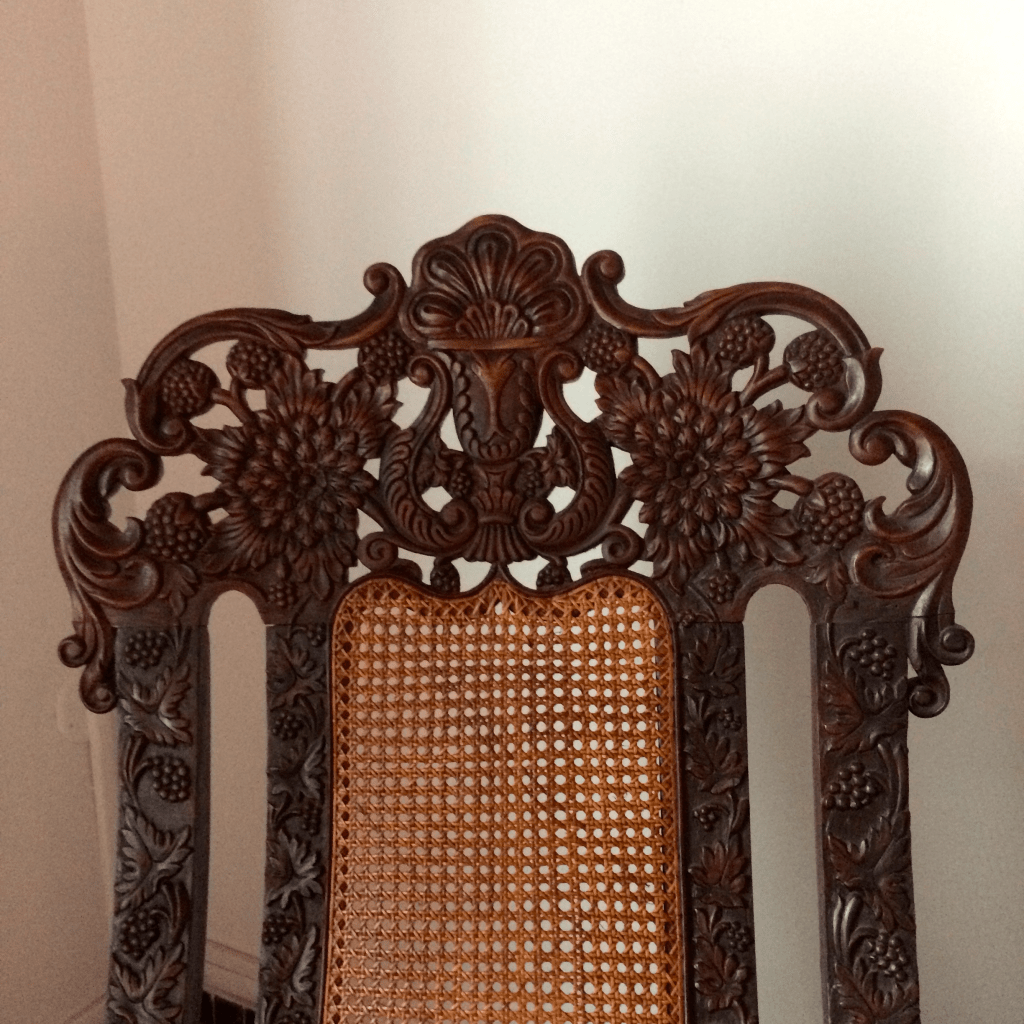
The rest of the decor belongs to a particular typology. The ornamental repertoire consisting of vines spreads over all available surfaces. It differs from other types of repertoires favouring a symbolic Islamic iconography – referring to the notion of garden of paradise – or borrowing figures from Hindu mythology, and vernacular elements from Dravidian architecture. Here, the grape leaves and grapes clearly reveal a Christian clientele. The top shell, a striking object in the seat’s ornamentation, is also a symbol of love, good luck and spiritual purification.

Folding armchair with a “swami”-type carved repertoire, India, Tamil Nadu, late 19th century. This type of decor features an abundant vegetal and animal repertoire (snake, elephant …) and characters borrowed from Hindu mythology but devoid of symbolic connotation. Rather, they are picturesque references echoing the prevailing orientalist fashion. This theme was very popular in the last quarter of the 19th century..
Christie’s auction in New York , July 17th-18th, 2007

Formal repertoire
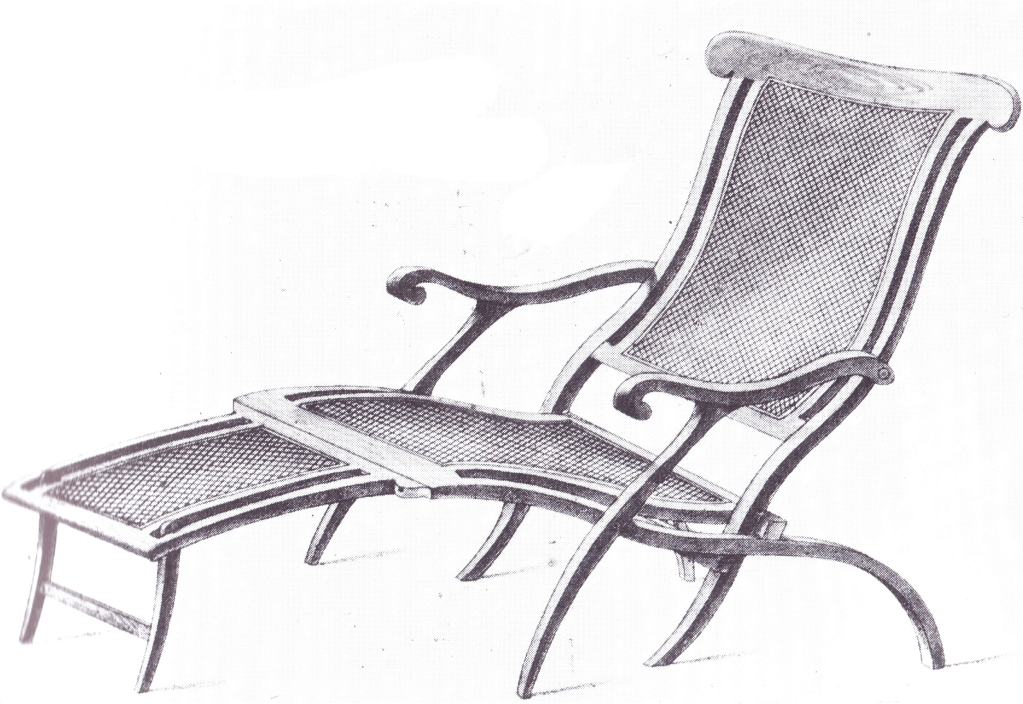
These folding armchairs (originally called deck chairs) derive from a model originally designed for the decks of commercial ships in the second half of the 19th century. A comfortable seat, easily foldable and stackable in case of bad weather: this model perfectly met the expectations of wealthy customers. The first models were in wood or rattan. They have a footrest – which can be removable – folding or sliding, armrests and sometimes a small canvas parasol on the backrest.
As early as the 1860s, English furniture catalogues understood the value of these seats. They unashamedly praised them to furnish the interiors of settlers living in India, China, Australia or elsewhere. In the tropical colonial world, this type of armchair was frequently found in verandas, i.e. covered spaces protected from the sun and the rain, between the inside and the outside.

Palace of Penae Sintra (Portugal). In the Indian salon, in the background, behind a large pedestal table with parasol, folding armchairs with their large multi-lobed backs present an abundantly sculpted and pierced repertoire.
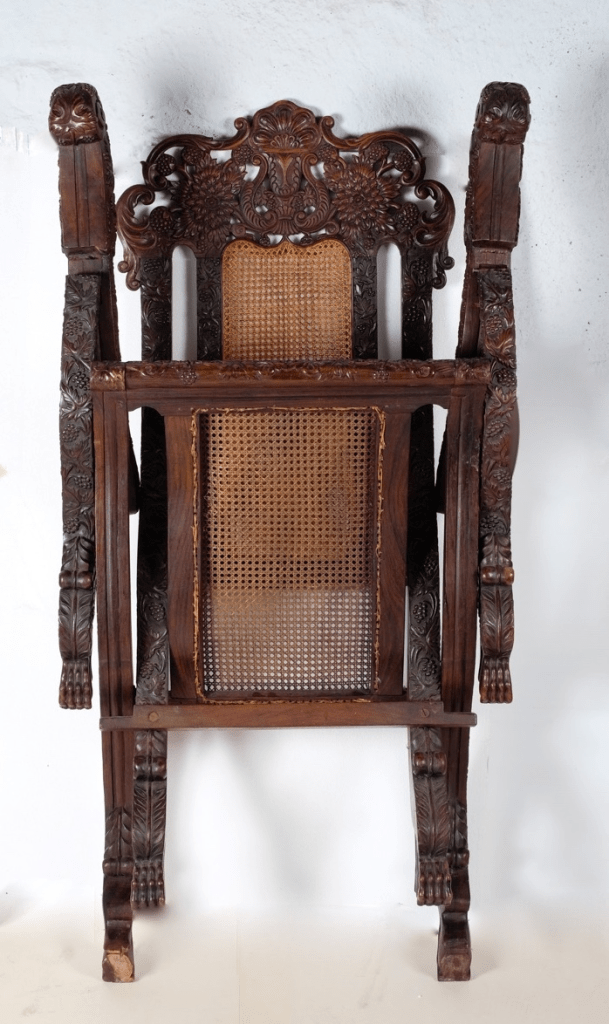
Exhibition
It’s a seat!, May – July 2016, musée des arts décoratifs de l’océan Indien, La Villa, Saint-Denis, reproduced in the dedicated catalogue, vol. 2.
Bibliography
- Audrey Bourgain, Sophie Thibier, Thierry-Nicolas Tchakaloff, C’est un siège !, (vol. 2) MADOI, Saint-louis 2016
- Amin Jaffer, Furniture from British India and Ceylon. A Catalogue of the Collections in the Victoria and Albert Museum and the Peabody Essex Museum. V&A, Londres, 2001
- Catherine Servan-Schreiber, « L’Inde et Ceylan dans les expositions coloniales et universelles (1851-1931) » in Nicolas Bancel, Zoos humains. Au temps des exhibitions humaines, Pla découverte, Paris, 2004, pp. 159-168
- Helder Carita, Les palais de Goa. Modèles et typologies de l’architecture civile indo-portugaise, éd. Chandeigne, 1996
- Jeremy Cooper, Victorian and Edwardian Furniture and interiors : from the gothic revival to art nouveau, éd Thames and Hudson, Londres, 1987
- Susan M. Wright, The decorative arts in the Victorian period, ed. Society of Antiquaries of London, 1989
- Thierry-Nicolas Tchakaloff, Quand les dieux s’assoient à la table des hommes, iconographie du panthéon hindou, MADOI, Saint-Louis, 2007
- Mordaunt Crook, The Rise of the Nouveaux Riches : Style and Status in Victorian and Edwardian Architecture, Jihn Murray, Londres, 1999
- Vidya Dehejia, Delight in Design. Silver for the Raj, Mapin, 2008
This article was originally written in French by Thierry-Nicolas Tchakaloff. Translation by Laurent Garcia.
 Lavilépi En
One thought on “Pair of folding armchairs”