

© Paul-Etienne Remy
Anglo-Indian conversation bench
Carved and pierced Indian rosewood, mobile upholstered seat
West India, Bombay Presidency, circa 1860-1880
Dimensions: H.: 92 x W.: 117 x D.: 85 cm
This two-seat sofa has two three-quarter offset backrests. They are gondola shaped, i.e. curved, enveloping and round. This sofa is named « conversation bench » because its particular design is intended to favour the conversation of two people. The low central element connecting the backrests has no support: it is supposed to prevent a third person from sitting.

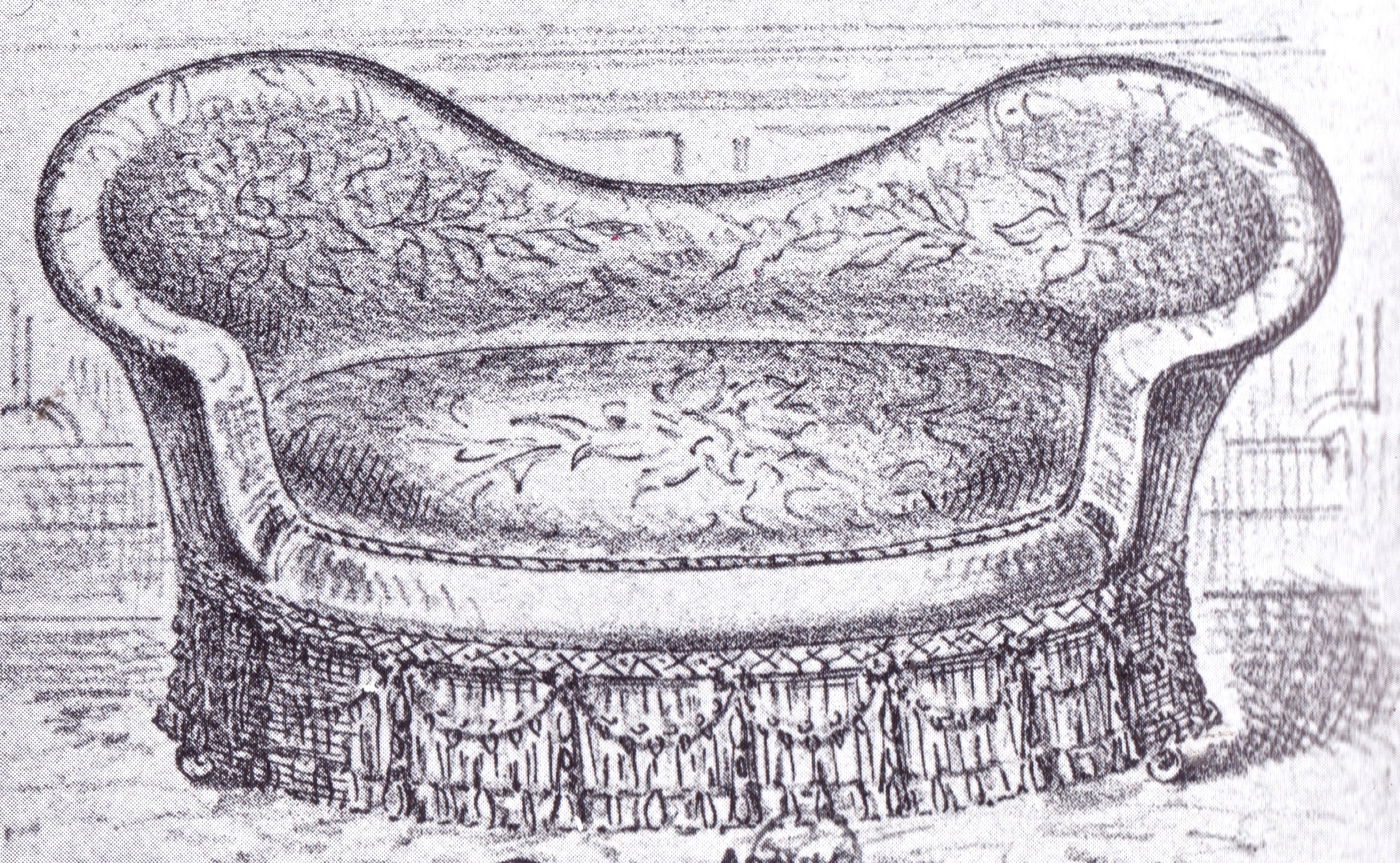
Couch for two. The old and modern furniture storage. Coloured lithograph from Désiré Guilmard’s The furniture storage, volume 1, 1839, p. 132 (detail).
Guilmard published a periodical publication of furnishings, The old and modern furniture storage. It had six issues per year made of nine lithographed plates without text, divided into three categories: seats, furniture and hangings of different styles.
Its carved and pierced upholstery decor covers all the visible sides of the furniture. It is organized symmetrically around the central axis of the sofa designated by the two oval medallions – located on the low waistband and in the centre of the backrest – decorated with a floral bouquet, and from the oval medallions in the backrests. The latter feature birds with long beaks, outstretched wings and long tails, perched among branches that seem to come out of their beaks. These medallions are hemmed with rows of pearls and florets. The backrest axis features two radiant rosette flowers around which networks of arabesques adorned with foliated volutes in which a myriad of birds evolves, develop. The curve of each backrest ends on half-open mouths of wild beasts from which a boteh leaf decorated with foliage scrolls springs. The thick feet rest on small runners and feature a bird motif resting on a feline’s head. They are connected by a wide, low concave belt decorated with the same ornamental register.

These pieces of furniture are called “Bombay Presidency”, after one of the three administrative entities of British India. In the Mascarenes, they are known under the name “India company” style.
This type of furniture, whose ornamental decorative registers offer many variations, had considerable success under the Victorian era and spread throughout the Indian peninsula (India, Sri Lanka), to the coast of East Africa, in areas of British, Portuguese and French influence. They could be found in the palaces of Goa as in Sintra in Portugal, Mauritius and La Reunion but also in Burma and Vietnam.
They were first made for the settlers but they quickly furnished the interiors of local elites. In fact, from the middle of the 19th century and the creation of the British Indian Empire, a significant change in the taste of the Indian elites takes place, with the use of Western objects, especially furniture, to equip their homes. Very quickly, local crafts, whose talent and skills were unanimously recognized, took over from imports in order to adapt Western models to the harsh climate, and create more cheaply.
Visiting foreign commentators note the abundance of this type of “richly carved Bombay rosewood” type of furniture, considered a mark of distinction. Already mentioned in the 1850s, they were also exported to Ceylon, but their popularity peaked between 1860 and 1880. Curves and counter-curves became more exuberant and the decorations were adorned with naturalistic motifs and superabundant volutes.

In the Indian Ocean, these pieces of furniture were frequently maintained with coconut oil in order to obtain a brilliant lustre, making possible the effects of lights on reflective surfaces. In these plush interiors, where the semi-darkness was expertly maintained, they no longer appeared as a compact and dark mass, but as dematerialized elements where the scintillating light seemed to explode through the myriad of openings.
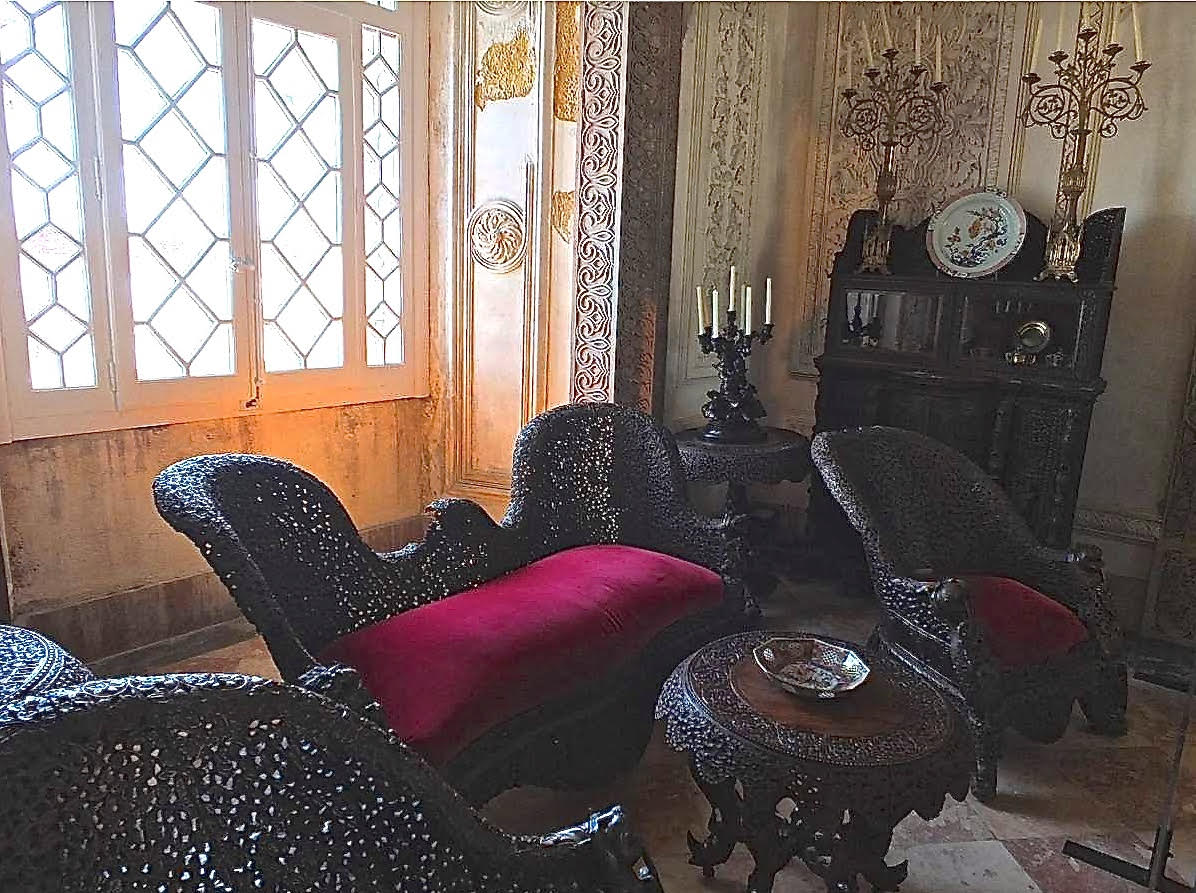
Pene Palace, Sintra (Portugal). The Indian lounge – or smokehouse – is fully furnished with exotic Indian pieces covering almost all the listed typologies. Here, a conversation sofa with similar lines. In addition, monopod pedestal tables with umbrella sashes, a small centre table and matching armchairs.
This carpentry and sculpture work is generally attributed to workers from Ahmedabad or Sura in Gujarat. There is a very old tradition of wooden house facades with very elaborate and richly carved decoration closely linked to myths and symbolism there. The workers moved and settled in Bombay to work for Parsi entrepreneurs. This reference to the old capital is certainly not trivial. This could explain the sense of the decor of this sofa where the entwined and intersecting plant systems symbolize the garden of paradise. Likewise, most of the doors and windows of havelis, these rich residences of Rajasthan and Gujarat akin to small palaces, feature jalis, i.e. openwork screens with a generally geometric ornamental pattern, in wood, metal or stone.
Wood
Indian rosewood – also called “Bombay blackwood” or “East Indian rosewood” – is actually Dalbergia Latifolia Roxb. It grows in tropical Asia, more specifically from Nepal to India and Java. It was used in the manufacture of high quality furniture. The heartwood is durable, resistant to drywood termites and rot fungi. Its grain is straight and moderately fine. Its colour varies from golden brown to purplish brown, with dark veins.
THE FORMAL DIRECTORY
This sofa’s complex shape is similar to that of the fully upholstered conversation sofas that were very fashionable at the end of Queen Victoria’s reign. The general line comes from the French “toad” seat, invented under the Restoration and then very fashionable under Napoleon III, before it was adopted in England. It is a comfortable seat whose frame is completely wrapped in fabric upholstery. Nevertheless, here, the exuberance of the curves undeniably brings us closer to that of papier-mâché furniture.
PAPiER-MÂCHÉ FURNITURE
This material could already be found in France in the 18th century in interior decoration or small objects. England greatly improved the process though and applied it to furniture. Henry Clay implemented this new tough and hard material in Birmingham in 1772. His trade was bought by Jennens and Brettidge in 1816, a firm active from 1815 to 1864. Jennens and Brettidge filed a patent in 1825 to add materials (mother-of-pearl, pearl or glass) to the varnish before drying and changing its composition. Their firm has been widely recognized for producing quality papier-mâché items. Enthusiasm for these products enabled the firm to set up branches in London in 1837, then in Paris and New York in 1839.
Papier-mâché pieces of furniture knew unprecedented success in this new consumer society that was in love with ostentatious luxury and comfort. They had particular appeal to a wealthy bourgeoisie. The economic interest combined with technological improvements made it possible to diversify their manufacture. In fact, steam engines made it possible to produce large-volume pieces such as side tables with tilting tops or seats – armchairs, chairs or sofas. The flexibility of the light and resistant material, its implementation adapted to the most complicated and exuberant shapes, moulded with great finesse and decorated with care.
The furniture was made from a mixture of cardboard paper, rags, sometimes straw, to which glue and other additives were added. This mixture was crushed then soaked before being sieved. The dough thus obtained was left to dry to remove excess water and thinned to get to the desired thickness before being moulded while still wet. The processes varied according to the firms which filed countless patents. Once it was hard enough, the created piece could receive several types of decoration as confirmed by the manufacturers’ sales catalogues that featured a wide variety of decorations. The same object could thus be delivered painted in trompe-l’oeil – faux marble, wood, tortoiseshell, etc. – covered with a star pattern on a plain background, or even decorated with a Chinese motif on a black or red background. Other figurative finishes were available such as bouquets of various flowers, a so-called “Russian” decoration – red and black hand painting on a gold background – a Japanese decoration on a black background, with mother-of-pearl inlays, the most popular of all. Floral or landscape motifs could be painted or transferred from a coloured lithograph. Finally, golden finishes completed the range of possibilities that could be mixed together.

Queen Victoria’s salon in lacquered papier-mâché, inlaid with mother-of-pearl, paintings and gilding. This living room features a conversation sofa on casters, a pair of gondola armchairs and a suite of four chairs on casters with openwork backs. It comes from Osborne Castle in Britain, which was built in 1847 for Queen Victoria. It was her favourite summer residence. The arched feet are borrowed from the Louis XV furniture repertoire and prove the French influence in the art of furniture at the end of Queen Victoria’s reign.
Similar furniture, only white lacquered, can be spotted in Albin and Renato’s apartment – the two main protagonists of Edouard Molinaro’s cult French comedy La cage aux folles (The Bird Cage, 1978).
A similar living room consisting of a sofa and two armchairs is kept at the Victoria and Albert museum in London (inv. No. IS 36-1975 and IS 37-1975). It was acquired in Bombay by Mr. and Mrs. James Richard Naylor, British settlers living in India, after their marriage in 1868.

Conversation sofa, carved and pierced Indian rosewood.
(Part of a set with a pair of gondola chairs).
This model’s only difference lies in the medallions representing a standing lion.
Sotheby’s New York, October 13th, 2013 auction

Exhibition
It’s a seat!, May – July 2016, musée des arts décoratifs de l’océan Indien, La Villa, Saint-Denis (see picture above), reproduced in the dedicated catalogue, vol. 1.
Bibliography
- Yvonne Jones, Japanned Papier-Mâché and Tinware, 1740-1940, Woodbridge, Antique Collector’s Club, 2012
- Jennens and Bettridge’s illustrated catalogue of papier mâché : Manufacturers, by Special Appointment, to Her Majesty, H. R. H. Prince Albert, and the Royal Family. Londres, 1851-1852, (reprint), éd. Forgotten Books, 2018
- Amin Jaffer, Furniture from British India and Ceylon. A Catalogue of the Collections in the Victoria and Albert Museum and the Peabody Essex Museum. V&A, Londres, 2001
- Catherine Servan-Schreiber, « L’Inde et Ceylan dans les expositions coloniales et universelles (1851-1931) » in Nicolas Bancel, Zoos humains. Au temps des exhibitions humaines, Pla découverte, Paris, 2004, pp. 159-168
- Helder Carita, Les palais de Goa. Modèles et typologies de l’architecture civile indo-portugaise, éd. Chandeigne, 1996
- Jeremy Cooper, Victorian and Edwardian Furniture and interiors : from the gothic revival to art nouveau, éd Thames and Hudson, Londres, 1987
- Susan M. Wright, The decorative arts in the Victorian period, ed. Society of Antiquaries of London, 1989
- Mordaunt Crook, The Rise of the Nouveaux Riches : Style and Status in Victorian and Edwardian Architecture, Jihn Murray, Londres, 1999
- Hélène Rossini, « Le papier mâché laqué. Un art méconnu » in Papiers en volume, traditions asiatiques et occidentales, actes de la journée du 4 novembre 2016 , s/dir. de Claude Laroque et Valérie Lee, HICSA
- Audrey Bourgain, Sophie Thibier, Thierry-Nicolas Tchakaloff, C’est un siège !, (2.vol.) MADOI, Saint-louis 2016
This article was originally written in French by Thierry-Nicolas Tchakaloff. Translation by Laurent Garcia.
 Lavilépi En
One thought on “Anglo-Indian conversation bench”